
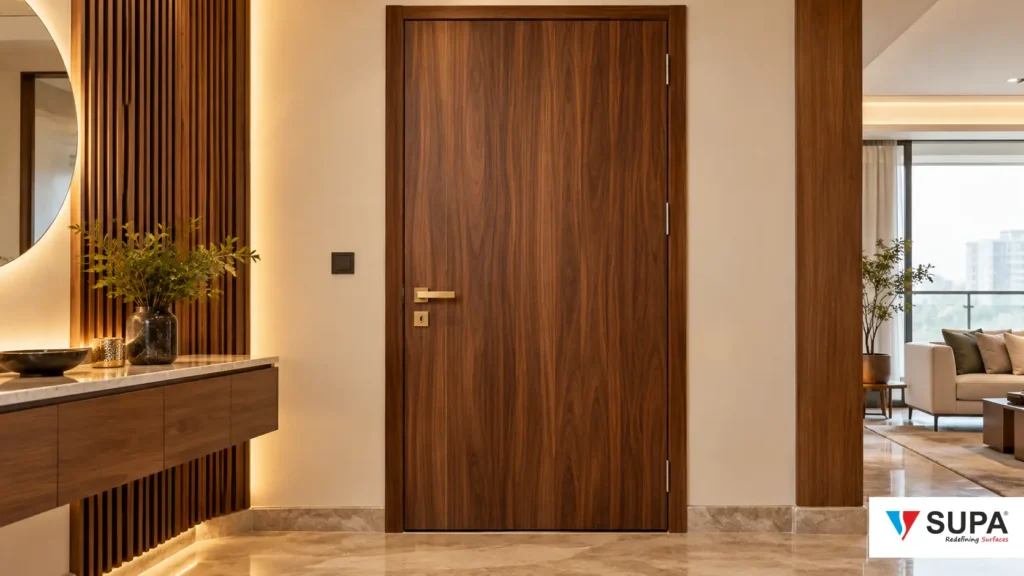
A door skin laminate is a decorative laminate sheet made in a door-sized format and bonded to the face of a flush door. It differs from a regular furniture laminate in its sheet size, in its designs, which are composed to fill a whole door, and in being made for the pressing that door manufacture involves. If you are finishing doors, choose a door skin, and keep 8 ft x 4 ft sheets for furniture.
What is a door skin?
A door skin is the decorative face of a flush door, supplied as a single sheet sized to cover one side of the door leaf. Two skins, one on each face, turn a plain flush door into a finished one.
The flush door underneath is a flat, engineered door with a solid or semi-solid core. On its own it has no decorative surface. The traditional ways to finish it are paint, polish over veneer, or a laminate. A door skin is the laminate route, made ready for the purpose.
The term causes some confusion, so it helps to separate three things people mean by it. In the laminate trade, a door skin is a laminate sheet in door format, which is the subject of this guide. In joinery, the phrase can also mean a thin plywood facing. And some suppliers use it for moulded panel faces with raised patterns.
How is a door skin different from a regular laminate sheet?
A door skin differs from a regular laminate sheet in format, in design layout and in intended use. The material family is the same. What changes is how the sheet is sized and composed.
| Feature | Door skin laminate | Regular furniture laminate |
|---|---|---|
| Sheet format | Door-sized, close to one door leaf | 8 ft x 4 ft |
| Design layout | Composed as one full-door picture: panels, borders, inlays, grooves | Continuous pattern that repeats across the sheet |
| Typical use | Faces of flush doors | Shutters, cabinets, tables, wall panels |
| Cutting | Trimmed to the door, little waste | Cut into many panels |
| Bonding | Usually pressed on at a door unit | Pasted on site or pressed at a furniture unit |
| Ordering unit | Per door face, in pairs | Per sheet |
The design point is the one buyers feel most. A door is seen whole, from a distance, every time someone walks through the house. Door skin designs are drawn for that view, with panel effects, vertical bands or a centred motif that sits correctly on a door. A furniture laminate cut down to door size gives you a slice of a repeating pattern instead.
What sizes and thickness do door skins come in?
Door skins are made in formats close to standard door sizes, so a single sheet covers one face with only a small trim. Indian flush doors are commonly around 7 ft high, with widths that vary by room, and door skins follow those dimensions.
The available sizes are listed in the door skin catalogue, and that is the list to work from when you match skins to your doors.
Before you order, measure the door leaf, not the opening. Note the height, the width and the thickness of the door, and check whether both faces are the same size.
On thickness, ask for the figure in writing as you would for any laminate. A door face takes knocks from luggage, furniture and children's toys, especially on the lower third, so thickness matters here more than on a wardrobe side. If you want to verify what arrives, the method in our guide on how to check laminate thickness works on door skins too. For how door formats compare with furniture sheets, see the laminate sheet size guide.
Can you use a normal laminate on a door?
You can, but a door skin is the better choice for a full door face. A normal 8 ft x 4 ft laminate will bond to a flush door, and carpenters do it. The result depends on the design and on how the door is pressed.
There are three practical problems with using furniture sheets. First, yield. A 4 ft wide sheet cut for a 3 ft door leaves a narrow strip that is hard to use, and you need two sheets for two faces. Second, design. A repeating woodgrain is fine, but you lose the composed panel look that makes a door read as a door. Third, bonding. A door is a large, single panel that hangs from one edge and gets slammed. It needs even pressure across the whole face when the skin is bonded, which a door press provides and hand pasting on site often does not.
Where a normal laminate does make sense is a flush shutter that should match adjoining furniture exactly, such as a concealed door within a wardrobe wall. There, continuity with the furniture matters more than a door design, and using the same sheet is the right call.
Which door skin finish suits which door?
The right finish depends on how much handling, light and moisture each door gets. A main door, a bedroom door and a bathroom door live very different lives.
Main door. This is the most seen door in the home and the one visitors touch. A rich woodgrain or a panel design with some texture suits it, because texture hides fingerprints and small scuffs. Remember that a laminate door skin is an interior-grade surface. A door that takes direct sun and rain on its outer face needs a product rated for exterior use.
Bedroom doors. These should sit quietly with the wardrobe and the flooring. A matte woodgrain in a tone close to the furniture works in most rooms. Using one design for all bedroom doors gives a corridor a calm, consistent look.
Bathroom and utility doors. The inner face meets steam and splashes. The surface copes well with moisture, but the edges and the bottom of the door are the weak points. Insist on sealed edges all round, including the top and bottom, which are often left raw.
Children's rooms and offices. Solid colours and lighter tones work here, and a matte finish is easier to live with than gloss on a door that is pushed open by hand all day.
Supalam lists Door Skins as a separate product line alongside its laminate ranges, with its own catalogue, so door designs are chosen from a door collection and not adapted from furniture sheets.
How is a door skin bonded to a flush door?
A door skin is bonded with adhesive under even pressure across the whole face, ideally in a press at a door manufacturing unit. That is the main reason factory-skinned doors stay flat and site-pasted doors sometimes do not.
The door face is sanded flat and cleaned. Adhesive is spread evenly. The skin is positioned, and the door goes under pressure until the bond sets. Both faces are skinned so the door stays balanced, for the same reason both faces of a shutter are covered. Then the edges are finished with lipping or edge band and the door is trimmed for hinges and the lock.
Two details separate a door that lasts from one that does not. The first is balance: both faces should carry a skin of similar thickness. The second is the edges. An unsealed top or bottom edge lets moisture into the core, and the skin starts lifting from that edge inward. A good edge band or solid lipping all round prevents it.
What should you check before ordering door skins?
Check five things before ordering: door size, quantity in faces, design code, thickness and edge finish. Getting them right at the start avoids the common problem of one mismatched door in a house.
- Measure every door leaf. List height, width and thickness room by room.
- Count faces, not doors. Ten doors need twenty skins. Decide whether both faces carry the same design.
- Fix the design code. Choose from the door skin catalogue and write the code on the order.
- Confirm thickness in writing. Put it on the quotation and the invoice.
- Agree the edge finish. Lipping or edge band, and the colour.
Order all the skins for a home in one lot so the tone is consistent from door to door. Supalam has made door skins as part of its product line since 2009, and the current range is on the Door Skins page. If the doors sit next to laminate furniture, pick the furniture sheet at the same time. Supalam offers its 1mm decorative laminates in woodgrains and solid colours that can be coordinated with a door design.
Frequently Asked Questions
What is a door skin made of?
A laminate door skin is a decorative laminate, built from resin-treated paper layers pressed under heat and pressure with a decorative surface on top. It is made in a door-sized sheet and bonded to the face of a flush door.
Is a door skin the same as sunmica?
They belong to the same material family. Sunmica is the common name for decorative laminate in India. A door skin is a decorative laminate made in a door format with a full-door design, while regular laminate comes in 8 ft x 4 ft sheets.
What size is a door skin sheet?
Door skins are made close to standard flush door sizes so one sheet covers one face. Exact sizes vary by manufacturer. Measure your door leaf and confirm the available sizes before ordering.
Can a door skin be used on bathroom doors?
Yes, on the faces. The surface handles moisture well. The risk is at the edges, so the top, bottom and sides of the door must be sealed with lipping or edge band to keep water out of the core.
How many door skins do I need per door?
Two, one for each face. A door skinned on one side only is unbalanced and can warp. Count faces when you order, and buy all skins for a project together for consistent colour.
Choose a door design that suits the home
See the Door Skins range, browse door designs in the e-catalogue, or contact the team with your door sizes.