
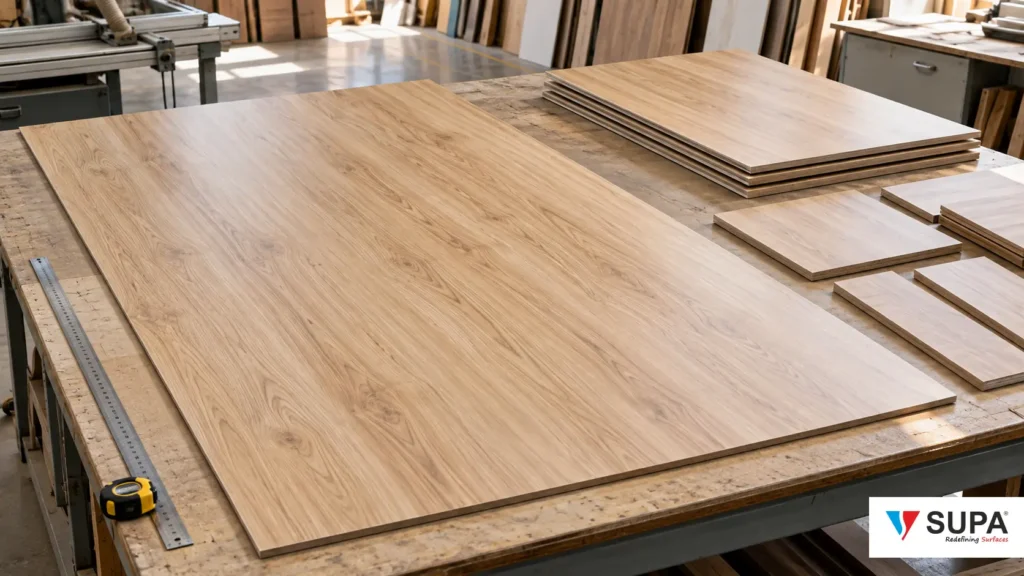
The standard laminate sheet size in India is 8 ft x 4 ft, which is 2440 mm x 1220 mm and covers 32 square feet. That size is the same whether the sheet is 0.8mm or 1mm thick, because thickness and sheet size are separate specifications. To know how many sheets a job needs, you plan the cuts panel by panel instead of dividing the total area by 32.
What size does a laminate sheet come in?
A decorative laminate sheet comes in a standard size of 8 ft x 4 ft across almost every range sold in India. In metric terms that is 2440 mm long and 1220 mm wide, or just under 3 square metres.
The size is not an accident. Plywood, MDF, particle board and block board are also sold in 8 ft x 4 ft, so one laminate sheet covers one face of one board with nothing left over. Carpenters, cutting machines and transport are all set up around that module.
Some ranges are also offered in longer sheets for tall shutters and full-height panels, where an 8 ft length would force a joint. Availability depends on the manufacturer and the design, so check before you finalise a drawing that depends on it.
Laminate sheet sizes in feet, mm and square feet
The table below converts the common sheet formats so you can read a drawing in either unit. Only the first row is universal. Treat the others as formats to confirm with your dealer. Supalam publishes a catalogue for each range, and that catalogue is the place to confirm the size of a specific design.
| Sheet format | Size in mm | Area in sq ft | Area in sq m | Where it is used |
|---|---|---|---|---|
| 8 ft x 4 ft (standard) | 2440 x 1220 | 32 | 2.98 | Furniture, shutters, wall panels |
| 10 ft x 4 ft (long sheet) | 3050 x 1220 | 40 | 3.72 | Full-height shutters and panels, where offered |
| Door skin (door-sized) | Close to one door leaf, varies by maker | Varies | Varies | Flush door faces |
Two conversions are worth remembering. One foot is 304.8 mm, so 8 ft is 2438 mm, which the trade rounds to 2440. And one square metre is 10.76 square feet, which is useful when an architect's drawing is in metric and the dealer quotes per sheet.
How many square feet does one laminate sheet cover?
One standard laminate sheet covers 32 square feet on paper and noticeably less in practice. The gap between the two is offcut, and it is the reason area-based estimates run short.
Think about a shutter that is 2 ft 3 in wide. You can cut only one such piece across the 4 ft width of a sheet. The remaining strip, 1 ft 9 in wide, is too narrow for a second shutter. It may do for a drawer front or a skirting, or it may go to waste. The sheet still measured 32 square feet. You used little more than half of it.
This is why two wardrobes with the same total area can need different numbers of sheets. Panel sizes decide the yield, not the area.
How do you calculate how many laminate sheets you need?
You calculate laminate sheets by listing every panel, fitting those panels onto 8 ft x 4 ft sheets, and then adding an allowance. Four steps cover it.
- List every laminated face. Write the height and width of each shutter, drawer front, exposed side, top and visible shelf edge. Count outer faces and inner faces separately, because they often use different sheets.
- Mark the grain direction. For woodgrain and linear designs, the grain usually runs vertically on shutters. That means the panel's height must come from the sheet's 8 ft length. For solid colours, panels can be turned either way, which saves material.
- Fit the panels onto sheets. Sketch a rectangle for each sheet and place the panels inside it, largest first. A cutting-list app or the carpenter's own layout does the same job.
- Add an allowance. Keep a margin for saw cuts, edge trimming, handling damage and one future repair.
Your carpenter's cutting plan is the best guide to how large that margin should be, because it depends on panel sizes and on the design.
Order all the sheets for one design in a single lot. Supalam identifies each design with a decor code, and quoting that code on a repeat order is how you ask for the same design again. Even so, buying the full quantity together is the safest way to keep adjoining shutters looking identical.
Worked example: a three-door wardrobe
A three-door wardrobe, 7 ft high and 6 ft wide, needs two standard sheets for its outer faces. Here is how the count is reached.
The three shutters are each 7 ft x 2 ft. The area method says 3 x 14 = 42 square feet, and 42 divided by 32 is 1.3, so you might hope for one and a half sheets. Sheets are not sold in halves, and the layout confirms two.
From the first sheet, the 4 ft width gives two strips of 2 ft, and the 8 ft length covers the 7 ft height. That is two shutters, with a 1 ft x 4 ft offcut left at the end. The third shutter comes from the second sheet, leaving a full 7 ft x 2 ft strip. That strip is exactly what an exposed side panel needs if the wardrobe is 2 ft deep and one side is visible.
So the outer faces take two sheets, with offcuts for a loft shutter or a drawer front. In reality each shutter is a few millimetres under 2 ft to allow for gaps, which helps the layout. The inner faces are a separate decision, covered in our guide to laminate for inside wardrobes and cabinets.
Change one number and the count moves. Make it a two-door sliding wardrobe with 3 ft wide shutters, and only one shutter fits across each sheet. The same 42 square feet now needs two sheets for two shutters, with wide offcuts. That is the point of planning by panel.
Why does grain direction change the number of sheets?
Grain direction changes the count because it removes your freedom to rotate panels on the sheet. A woodgrain shutter must be cut along the length of the sheet so the grain runs top to bottom, and every adjoining shutter must follow the same direction.
With a solid colour, a 3 ft x 2 ft drawer bank front can be turned sideways to fill an awkward offcut. With a woodgrain, turning it would send the grain horizontally on one piece and vertically on the next. On a finished wardrobe that reads as a mistake from across the room.
Three habits keep grain under control. Decide the direction on the drawing before cutting. Cut adjoining shutters from the same sheet or from consecutive sheets. And for large stone or bookmatch patterns, look at the full sheet, not a small sample, before you order. Ranges with strong pattern movement need more sheets than a solid colour doing the same job. A plain range such as 1mm Unitop solid colour laminates is the most economical on yield for exactly this reason.
Do thickness and sheet size affect each other?
No, thickness and sheet size are independent. A 0.8mm sheet and a 1mm sheet in the same range family are both 8 ft x 4 ft, so your sheet count does not change when you move between them. Your cost per sheet does.
What changes with thickness is where each sheet goes. A common plan is 1mm on outer faces and a thinner or pre-laminated surface inside. That means two separate sheet counts on the same job. Keep them on separate lines of the estimate, and read our 1mm vs 0.8mm laminate comparison if you have not settled the split yet.
Boards follow the same module. Supalam supplies pre-lam boards in board format with the decorative surface already applied to both faces, which removes the laminate count for carcass panels altogether. For current sheet pricing by tier, see the laminate sheet price guide.
Frequently Asked Questions
What is the standard size of a laminate sheet in mm?
The standard laminate sheet is 2440 mm x 1220 mm, which is 8 ft x 4 ft. It covers 32 square feet, or about 2.98 square metres. This size matches standard plywood and board sizes.
How many laminate sheets do I need for a wardrobe?
A three-door wardrobe 7 ft high and 6 ft wide needs two standard sheets for the outer faces. Inner faces are counted separately. The exact number depends on shutter width and grain direction, so plan the cuts panel by panel.
Do all laminate brands use the same sheet size?
Almost all decorative laminate ranges in India use 8 ft x 4 ft as the standard. Some manufacturers also offer longer sheets in selected designs. Door skins are made in door-sized formats and should be checked separately.
Is a 1mm laminate sheet bigger than a 0.8mm sheet?
No. Both are sold in the same 8 ft x 4 ft size. Thickness affects durability and price, not the area a sheet covers.
How much extra laminate should I order?
Order enough to cover saw cuts, trimming, damage in handling and one possible repair later. The right margin depends on panel sizes and grain direction. Buy the full quantity in one lot so the design and shade stay consistent.
Plan the sheets before you order
Shortlist designs in the laminate e-catalogue, see the full 1mm decorative laminates range, or contact the team with your cutting list for help with quantities.