
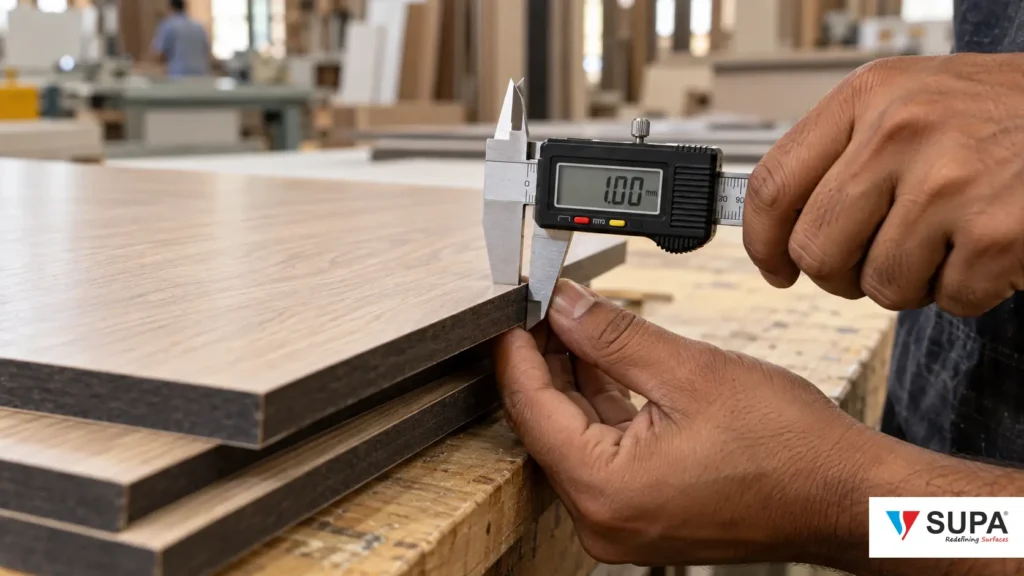
You check laminate thickness by reading the print on the back of the sheet and then confirming it with a digital caliper at three or more points away from the edge. A sheet sold as 1mm should read close to 1mm, and a 0.8mm sheet will show the gap clearly on any caliper that reads to two decimal places. Do both checks before the adhesive goes on, because once a sheet is pasted the only evidence left is a cut edge.
Can you tell 1mm from 0.8mm laminate by eye?
No, you cannot reliably tell 1mm from 0.8mm laminate by looking at the face of the sheet. The decorative paper, the texture and the colour can be identical across both thicknesses, and the difference between them is one fifth of a millimetre.
There are a few hints that experienced carpenters use. A 1mm sheet feels a little stiffer when you lift one corner of a full sheet. It also sits flatter when a stack is carried on its side. Both are impressions, though, and both change with the finish and with how long the stock has been stored. Treat them as a reason to measure, never as the measurement.
The reason this matters is simple. Thickness is one of the main things you pay for. If a quotation says 1mm for shutters and 0.8mm arrives on site, the furniture will look the same on handover day and behave differently over the years. Our 1mm vs 0.8mm laminate comparison explains where that difference shows up.
What is printed on the back of a laminate sheet?
The back of a laminate sheet normally carries the manufacturer's brand, the range and a repeating print that identifies the product. This back print is the first thing to read, because it tells you who made the sheet and which range it belongs to before any tool comes out.
Look for three things:
- The brand or manufacturer name, repeated across the back
- The range name or thickness tier
- A design or decor code, either on the back, on an edge sticker or on the protective film
Match the decor code with the code in the catalogue or on your approved sample. A mismatch here is a bigger warning sign than any caliper reading. Supalam names each range with its thickness tier, such as 1mm Unitop solid colour laminates and 0.8mm Supa Intro laminates, so the range name on the invoice already tells you what thickness to expect.
A plain brown back with no print at all does not prove a sheet is poor. It does mean you have nothing to trace, so the caliper check becomes essential.
How do you measure laminate thickness with a caliper?
You measure laminate thickness by closing a digital vernier caliper gently on a clean, flat part of the sheet and reading the display in millimetres. A basic digital caliper reads to 0.01mm and is accurate enough for this job. A steel ruler or a measuring tape is not.
Follow these steps on site:
- Wipe the spot on both faces. Dust, film or dried glue will add to the reading.
- Peel back the protective film on gloss and acrylic finishes at the spot you measure.
- Zero the caliper with the jaws closed.
- Measure at least 25mm in from the edge. Edges can be slightly crushed from cutting or handling.
- Close the jaws until they touch. Do not squeeze. Laminate compresses very little, but heavy pressure still shifts a reading.
- Take three readings on each sheet: near two opposite corners and near the middle of one long side.
- Check two or three sheets from the lot, not just the top one.
- Write the readings on the delivery challan with the date.
On textured finishes, the jaws rest on the peaks of the texture. A deep texture can read slightly higher than a smooth sheet of the same build. Compare like with like, and if in doubt, measure a smooth sheet from the same range.
What thickness tolerance is normal for a 1mm laminate?
A small variation around the labelled thickness is normal for every laminate, because the sheet is pressed from layers of resin-treated paper. The labelled figure is called the nominal thickness. The sheet in your hand will read a little above or below it, and the allowed band is set by the product standard and by the manufacturer.
In India, decorative laminates are covered by IS 2046. The manufacturer's own technical data sheet states the figure for a specific range, and that is the document to ask for when a project needs it in writing.
What you are checking for on site is not a perfect 1.00. You are checking that the readings cluster around the labelled thickness and that they do not sit at the next tier down. A sheet sold as 1mm that reads consistently near 0.8mm is a different product. A sheet that reads a few hundredths either side of 1mm is doing what it should.
Four ways to check laminate thickness compared
The four checks below work best together, and the caliper is the only one that gives you a number. Use the table to decide what to do at each stage of a job.
| Check | Tool needed | When to do it | What it tells you | Reliability |
|---|---|---|---|---|
| Back print and decor code | None | On delivery | Brand, range and design match the order | High for identity, none for thickness |
| Caliper reading | Digital vernier caliper | Before pasting | Actual thickness in mm | High |
| Invoice and challan match | Paperwork | On delivery | Range and thickness that were billed | Medium |
| Cut edge inspection | Caliper or magnifier | After pasting | Thickness at an exposed edge | Low to medium |
Start with the paperwork and the back print, because they take a minute and catch the obvious errors. Bring the caliper out for anything going on shutters, drawer fronts or other surfaces where you specified 1mm on purpose.
Can you check laminate thickness after it is pasted?
Yes, but only roughly, and only where an edge is exposed. Once the sheet is bonded to plywood or board, the glue line and the substrate make a clean reading difficult.
There are three places to look. The first is an offcut. Ask the carpenter to keep the offcuts from every sheet until the job is signed off, and measure those. The second is an unbanded edge, such as the back edge of a shelf, where the dark core line of the laminate is visible above the board. The third is a hardware cut-out, such as a hinge cup or a handle hole, before the fitting goes in.
If none of those are available, you are left with paperwork. That is why the checks belong at delivery, not at handover.
What should you ask the dealer before buying?
Ask the dealer for the range name, the thickness and the decor code in writing on the quotation and again on the invoice. Verbal descriptions such as "one mm quality" or "heavy sheet" protect nobody.
A short list that works:
- Which brand and which range is this sheet from?
- What thickness is written on the invoice?
- Can I see the catalogue page with this decor code?
- Is matching edge band available for this design?
- Can I measure one sheet before the lot is loaded?
A dealer with genuine stock will not mind the last question. Supalam publishes its range catalogues online, so you can check a decor code against the laminate e-catalogue on your phone while you stand in the shop.
Why does 0.2mm matter on a finished shutter?
The extra 0.2mm matters because it adds body to the surface that takes daily contact. A thicker sheet is more forgiving of small flaws in the board beneath, holds a deeper texture and stands up better at edges and corners, which is where most furniture shows its age first.
That does not make 0.8mm a poor product. It is the sensible choice for surfaces that are seen but not handled much, and for interiors where cost matters more than wear. The problem is only substitution: paying for one and receiving the other.
Edges deserve the same attention as faces. A correctly specified sheet with a badly matched or badly applied edge will still fail early, so confirm the edge band for 1mm laminates at the same time as the sheet. Supalam manufactures its laminates at Sampla in Rohtak district, Haryana, and coordinates edge band finishes with its laminate designs, which removes one more variable from the job.
Frequently Asked Questions
Is 1mm laminate exactly 1mm thick?
Not exactly. 1mm is the nominal thickness, and every pressed laminate has a small permitted variation around it. Readings that sit close to 1mm across several points are normal. Readings that sit near 0.8mm are not.
Which tool is best for measuring laminate thickness?
A digital vernier caliper that reads to 0.01mm is the right tool. A micrometer is more precise but slower on site. Rulers, tapes and thickness cards are not accurate enough to separate 1mm from 0.8mm.
Does a thicker laminate sheet weigh more?
Yes. A 1mm sheet of the same size and finish weighs more than a 0.8mm sheet because it contains more material. Weight is a useful cross-check for a full stack, but it is not a substitute for measuring individual sheets.
How do I know if my carpenter used 1mm or 0.8mm laminate?
Measure the offcuts with a digital caliper and compare the decor code on the back with your invoice. If the offcuts are gone, check an unbanded edge or a hinge cut-out. Agree before work starts that offcuts stay on site until handover.
Should I check every sheet in the lot?
No, a sample is enough for most home projects. Measure two or three sheets from different positions in the stack, with three readings on each. If any sheet reads a full tier lower, check the rest before pasting begins.
Specify the thickness, then verify it
Browse the 1mm decorative laminates range, compare designs in the e-catalogue, or contact the team for samples and dealer details.