
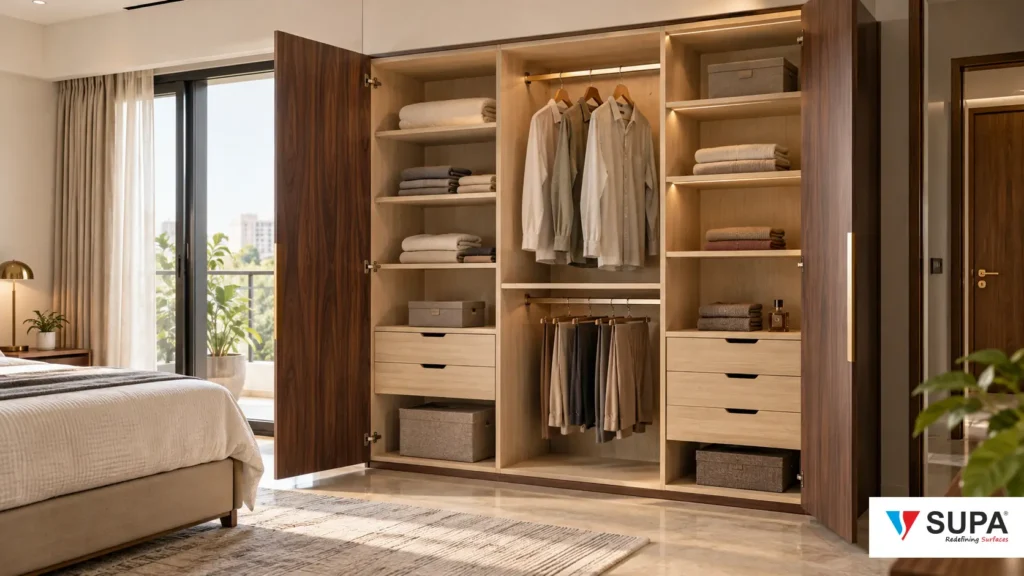
The inside of a wardrobe or cabinet is finished in one of three ways: a thin liner laminate, a 0.8mm decorative laminate, or a pre-laminated board that needs no pasting at all. Liner is the economy route, 0.8mm gives a better-looking and tougher interior, and prelam board is the fastest and most consistent for carcass work. The right choice depends on how often the interior is seen and how much site labour you want to pay for.
Why do the inner surfaces need laminate at all?
Inner surfaces need a laminate for two reasons: protection and balance. Protection is the obvious one. Bare plywood or board absorbs moisture, stains easily, snags clothes and is hard to wipe clean.
Balance is the reason carpenters insist on it even where nobody will look. A laminate sheet glued to only one face of a board changes how that face responds to humidity. The covered side stays stable while the bare side takes in and gives off moisture with the seasons. Over time the panel bows toward one side. A shutter that was flat in February can be rubbing against its neighbour by August.
Covering both faces with a similar material keeps the pull even. That is why the inner face of a shutter gets a sheet even in the most budget-conscious job. The only real decision is which sheet.
What is liner laminate?
Liner laminate is a thin, plain decorative laminate made for the hidden and inner faces of furniture. It is usually around 0.7mm thick, sold in a small palette of whites, off-whites and simple colours, and priced below the decorative ranges.
Its job is to balance the panel and give a clean, wipeable interior at the lowest cost. It is not designed to be the star of the room. Design choice is limited, the surface is plain, and on a large open interior it can look flat next to a well-finished exterior.
Some trade terms you will hear for the same idea are liner, backer, inner mica and balancing sheet. They are used loosely on site, so always confirm the thickness and the finish instead of relying on the name.
When is 0.8mm laminate the better choice inside?
0.8mm laminate is the better interior choice when the inside is seen often or handled hard. Think of open shelving, walk-in wardrobes, glass-front crockery units, and the inner faces of shutters that stay open while you cook.
Compared with a liner, a 0.8mm decorative sheet gives you three things. You get real design choice, so the interior can match or complement the outside. You get a little more body in the sheet, which helps on shelves that take sliding loads. And you can use one range for both the inner faces and any low-contact outer faces, which simplifies ordering.
The 0.8mm Supa Intro laminates range sits in this role. Supalam positions Supa Intro as its 0.8mm tier, below the 1mm and 1mm+ ranges used on shutters and visible faces. A light woodgrain or a soft neutral inside a dark wardrobe also makes the contents easier to see, which is a practical benefit people notice every morning.
Where 0.8mm is not needed is the truly hidden surface: the back of a base cabinet, the top of a loft, the underside of a fixed shelf. A liner or a prelam board does that job for less.
When does a prelam board replace both?
A prelam board replaces both liner and 0.8mm laminate whenever the whole carcass can be cut from finished board. The decorative surface is fused to both faces of the board at the factory, so there is no adhesive, no pressing and no waiting on site.
That changes the economics of carcass work. The panel arrives balanced, because both faces are already covered. The finish is uniform from board to board. The carpenter's time goes into cutting, edge banding and assembly, not into pasting sheets on the inside of every box. For modular kitchens and factory-made wardrobes, that is why prelam is the default for carcasses.
There are limits. Prelam surfaces are made for vertical and low-wear use, so they suit carcass sides, shelves and backs better than shutter fronts that take daily contact. Design choice is narrower than in the laminate ranges. And every cut edge must be sealed with edge band, because an exposed board edge is where moisture gets in.
Supalam supplies pre-lam boards alongside its laminate sheets, so the carcass and the shutters can be planned together. For the difference in how the two surfaces are made, see our explainer on HPL vs LPL laminates, and for board choice, the guide to prelam MDF in modular furniture.
Liner vs 0.8mm laminate vs prelam board
The three routes differ most in labour and in how the interior looks, less in how long they last when installed correctly. Use the table to match the route to the job.
| Factor | Liner laminate | 0.8mm laminate | Prelam board |
|---|---|---|---|
| Material cost | Lowest of the three sheets | Higher than liner | Board and surface in one price |
| Site labour | Pasting needed | Pasting needed | No pasting, only cutting and edging |
| Design choice | Very limited | Wide | Moderate |
| Look of the interior | Plain | Finished, can match exterior | Clean and uniform |
| Best for | Hidden faces, shutter backs | Visible interiors, open shelves | Carcass sides, shelves, backs |
| Watch out for | Flat appearance on open units | Cost on large hidden areas | Unsealed cut edges |
Many good projects use all three. Prelam board for the carcass, 0.8mm on open or glass-front sections, and a liner on shutter backs is a combination that spends money only where it shows.
What do kitchen interiors need that wardrobes do not?
Kitchen interiors need better protection at the edges and at the base, because they face water, steam and spills that a wardrobe never sees. The surface itself matters less than how well every edge is sealed.
Three places decide how a kitchen carcass ages. The first is the sink unit, where a slow leak can sit unnoticed. The second is the bottom edge of base cabinets, which meets mopping water. The third is any cut-out for pipes or wiring, which exposes raw board. In each case, a sealed edge and a wipeable inner face are what keep the board dry.
For that reason, do not economise on edge band inside a kitchen. Use a properly bonded edge band on every cut edge, including the ones at the back that nobody sees. On the inner faces, a 0.8mm sheet or a prelam surface both wipe clean easily. A wardrobe interior can be chosen mainly for looks. A kitchen interior should be chosen for how it handles a wet cloth every day.
How should the interior relate to the outside?
The interior should be lighter and calmer than the exterior in most furniture. A pale, low-pattern inside makes contents visible, hides dust less harshly than a dark surface, and lets the outer finish do the talking.
A few working rules help. Keep one interior finish across a whole run of wardrobes so open doors look consistent. Match the inner face of a shutter to the carcass interior, not to the shutter front, unless the unit is a display piece. And choose the outer sheet first, then pick an interior that sits quietly beside it. The outer faces are where a 1mm decorative laminate belongs. Our guide to the best laminates for wardrobe design covers that half of the decision.
Finally, write the interior specification on the quotation. "Inside: laminate" is not a specification. "Carcass in prelam board, shutter backs in liner, open shelves in 0.8mm" is. Supalam names its ranges by thickness tier, which makes that line easy to write and easy to check on delivery.
Frequently Asked Questions
Which laminate is used inside cupboards?
Cupboard interiors are usually finished with a thin liner laminate, a 0.8mm decorative laminate or a pre-laminated board. Liner is the lowest-cost option, 0.8mm looks better on visible interiors, and prelam board avoids pasting on carcass panels.
Is liner laminate necessary on the inner side of a shutter?
Yes, some sheet is necessary on the inner face. A shutter laminated on only one side is unbalanced and tends to bow as humidity changes. A liner or a 0.8mm sheet on the back keeps the panel flat.
Can I use 0.8mm laminate inside wardrobes?
Yes. 0.8mm laminate is well suited to wardrobe interiors, especially open shelves and sections that are seen often. It offers more design choice and a little more body than a liner sheet.
Is prelam board good for wardrobe interiors?
Yes, prelam board is a practical choice for carcass sides, shelves and back panels. It arrives finished on both faces, so no pasting is needed. Every cut edge must be sealed with edge band.
Should the inside laminate match the outside?
It does not need to. A lighter, plainer interior usually works better because it makes contents easier to see and lets the outer finish stand out. Keep the interior consistent across adjoining units.
Plan the inside with the outside
See the 0.8mm Supa Intro laminates and pre-lam boards, compare designs in the e-catalogue, or contact the team for samples.