
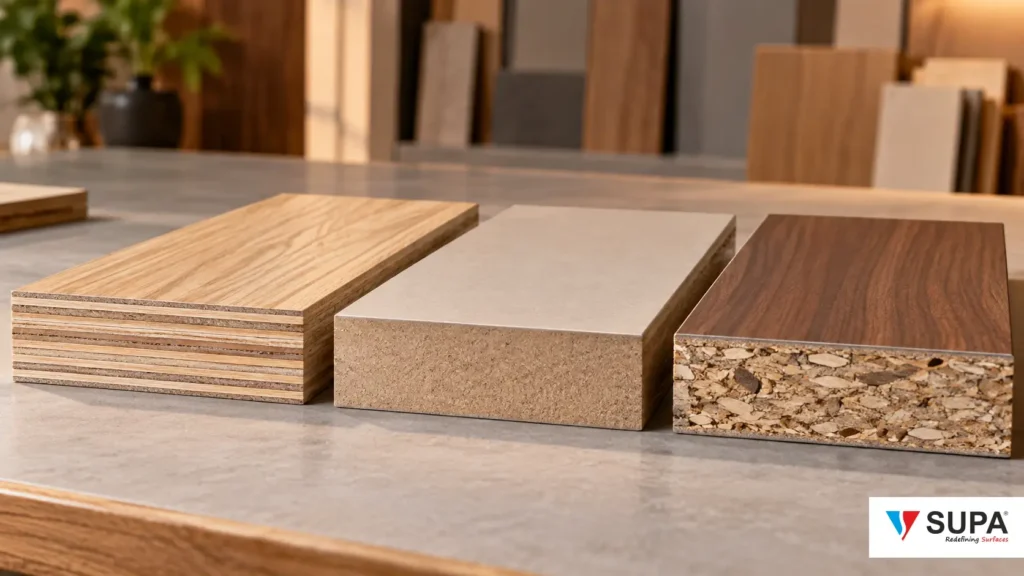
Laminate can be pasted on plywood, MDF and particle board, and the best base depends on where the panel will live. Plywood is the safer choice near water and for panels that carry weight, MDF gives the flattest and cleanest face for shutters, and particle board is the economical choice for carcasses in dry rooms. The laminate decides how furniture looks on day one, while the board decides how it holds up after five monsoons.
Why does the board matter if the laminate is the same?
The board matters because a laminate sheet is a surface, not a structure. It gives colour, texture and a hard-wearing face. Everything else, including strength, screw grip and resistance to swelling, comes from what is underneath.
Two wardrobes can carry the identical sheet and age very differently. On one, the shutters stay flat and the hinges stay tight. On the other, a hinge screw works loose, a bottom edge swells after mopping, and the face shows a faint ripple under evening light. The sheet was never the difference.
There is also a visual reason. A laminate follows the surface it is bonded to. Any dip, core gap or ridge in the board can show through as a slight wave, and gloss finishes show it most. A flat board is what makes a good sheet look expensive.
When is plywood the right base for laminate?
Plywood is the right base when the panel faces moisture, carries load or needs screws that will be tightened more than once. That covers most kitchen carcasses, sink units, bathroom vanities, bed boxes and long shelves.
Its strengths come from how it is built. Thin wood veneers are glued with the grain crossing layer to layer, which gives stiffness in both directions and a firm grip for screws. Moisture-resistant and boiling-water-resistant grades cope with damp conditions far better than fibre or particle boards.
Plywood has two weaknesses under laminate. The face is not always perfectly even, and small core gaps can exist inside the sheet. For large gloss shutters, ask for calibrated plywood, which is sanded to a uniform thickness. And price: good plywood costs more than the other two boards, so it makes sense to use it where its strengths are needed and not on every panel in the house.
When is MDF the right base for laminate?
MDF is the right base when the priority is a flawless, flat face. It is made from fine wood fibres pressed into a dense, uniform panel, so there is no grain, no knots and no core gaps to show through the sheet.
That makes it a strong choice for wardrobe shutters, drawer fronts, wall panels and any surface finished in high gloss or a solid colour, where the eye catches every ripple. Edges machine cleanly, so edge band sits tight and straight. Thickness is consistent from board to board, which helps on a long run of shutters that must line up.
The trade-off is water. Standard MDF swells if moisture gets into an unsealed edge, and once swollen it does not recover. It is also heavier than plywood, and screws driven into its edge hold less well than screws into its face. Keep standard MDF for dry rooms, seal every edge, and choose a moisture-resistant grade for kitchens if MDF is the plan there.
When does particle board make sense under laminate?
Particle board makes sense for carcasses, shelves and back panels in dry rooms, where cost and speed matter more than load. It is the lightest and most economical of the three boards and is widely used in modular and factory-made furniture.
Most particle board in furniture is not pasted on site at all. It arrives pre-laminated, with a decorative surface fused to both faces at the factory. That removes adhesive, pressing and drying from the job. Supalam supplies pre-lam boards for this purpose, so the carcass can be cut and edged while the shutters are finished separately in a laminate sheet. Our guide to prelam MDF in modular furniture explains where the MDF version fits.
Its limits are clear. Particle board has the lowest tolerance for water of the three, the weakest grip when a screw is removed and refitted, and it sags sooner on long, loaded shelves. Use it within those limits and it performs well for years. Push it into a sink unit or a bookshelf with a wide span and it will disappoint.
Plywood vs MDF vs particle board under laminate
The three boards differ most in flatness, screw holding and moisture tolerance. The table compares them on the points that affect a laminated panel.
| Factor | Plywood | MDF | Particle board |
|---|---|---|---|
| Face flatness | Good, best when calibrated | Excellent | Good |
| Screw holding | Strong | Fair on face, weak on edge | Weakest, poor on refitting |
| Moisture tolerance | Best, in resistant grades | Low unless moisture-resistant grade | Lowest |
| Weight | Medium | Heavy | Light |
| Relative cost | Highest | Middle | Lowest |
| Best laminated use | Kitchens, wet zones, load-bearing panels | Shutters, gloss faces, wall panels | Dry-room carcasses, shelves, backs |
No single board wins every row. That is why well-built furniture usually mixes them: one board for the carcass, another for the shutters.
Which board should you use for each part of the furniture?
Match the board to the job each panel does. A simple set of rules covers most homes.
- Kitchen base units and sink cabinets. Moisture-resistant plywood. Water finds these panels sooner or later.
- Kitchen wall units and tall units. Plywood, or a moisture-resistant fibre board where the area stays dry.
- Kitchen and wardrobe shutters. MDF or calibrated plywood for a flat face, finished in a 1mm decorative laminate.
- Wardrobe carcass in a bedroom. Pre-laminated particle board or MDF. Dry room, low load, large area.
- Long shelves and loaded spans. Plywood or block board, which resist sagging better.
- Wall panels and feature surfaces. MDF for flatness, with the edges sealed.
- Bathroom vanities. Water-resistant plywood only, with every edge sealed.
For the inside faces of these units, the options are covered in our guide on HPL vs LPL laminates. Supalam offers laminate sheets in 1mm and 0.8mm tiers, including 1mm Unitop solid colour laminates for shutters and 0.8mm Supa Intro laminates for lighter-use surfaces, so the sheet can be matched to the board and the location.
Does the laminate thickness change with the board?
The board does not dictate the laminate thickness, but it changes how much the thickness helps. A thicker sheet has more body and hides small surface flaws better, which matters most on boards that are less than perfectly flat.
On a smooth, dense board, a 0.8mm sheet and a 1mm sheet will both lie flat. The 1mm sheet still gives better wear at edges and corners. On site-grade plywood with minor unevenness, the 1mm sheet is noticeably more forgiving. So if the budget forces a compromise, do not pair the thinnest sheet with the roughest board on a surface people will see and touch every day.
Our 1mm vs 0.8mm laminate comparison sets out which thickness suits which surface. Once the sheets arrive, the method in how to check laminate thickness confirms you received what was specified.
What should you check on the board before pasting laminate?
Check that the board is flat, dry and clean, and plan to cover both faces and seal every edge. Most bonding failures blamed on the laminate begin with one of these five points being skipped.
- Flat. Lay a straight edge across the board. Reject panels that rock or show daylight.
- Dry. Do not use boards stored against a damp wall or on a wet floor.
- Clean. Wipe off sanding dust. Adhesive sticks to dust, and dust sticks to nothing.
- Balanced. Cover both faces with a similar material so the panel does not bow.
- Sealed. Edge band every cut edge, including the ones nobody sees.
The last point matters more for MDF and particle board than for plywood, because their edges absorb water fastest. Supalam makes Supa Edge Band in PVC and ABS, in 0.8mm, 1mm, 2mm and 3mm thicknesses, and the Supa Edge Band range is coordinated with its laminate designs. For the pasting sequence itself, follow the steps in how to apply laminate on furniture.
Frequently Asked Questions
Can laminate be pasted on MDF?
Yes. MDF is one of the best bases for laminate because its face is smooth and uniform. Use an adhesive made for decorative laminate, cover both faces and seal the edges. Choose a moisture-resistant grade for kitchens.
Which board is best under laminate for kitchen cabinets?
Moisture-resistant plywood is the safest choice for kitchen base units and sink cabinets. Shutters can be made in MDF or calibrated plywood for a flatter face. Whatever the board, sealed edges are what protect it from water.
Is plywood better than MDF for laminate shutters?
It depends on the priority. Plywood holds hinge screws better and tolerates moisture. MDF gives a flatter face, which shows on gloss and solid colour shutters. Calibrated plywood offers a middle path.
Can laminate be applied on particle board?
Yes, and it is common in modular furniture. Particle board is usually bought pre-laminated for carcass work. Keep it to dry rooms, avoid long loaded spans and seal every cut edge with edge band.
Does a thicker laminate make a weak board stronger?
No. Laminate adds surface protection, not structural strength. A 1mm sheet hides minor surface flaws better than a 0.8mm sheet, but it cannot stop a weak board from sagging or swelling.
Choose the board and the sheet together
See the 1mm decorative laminates range and pre-lam boards, compare designs in the e-catalogue, or contact the team for samples.