
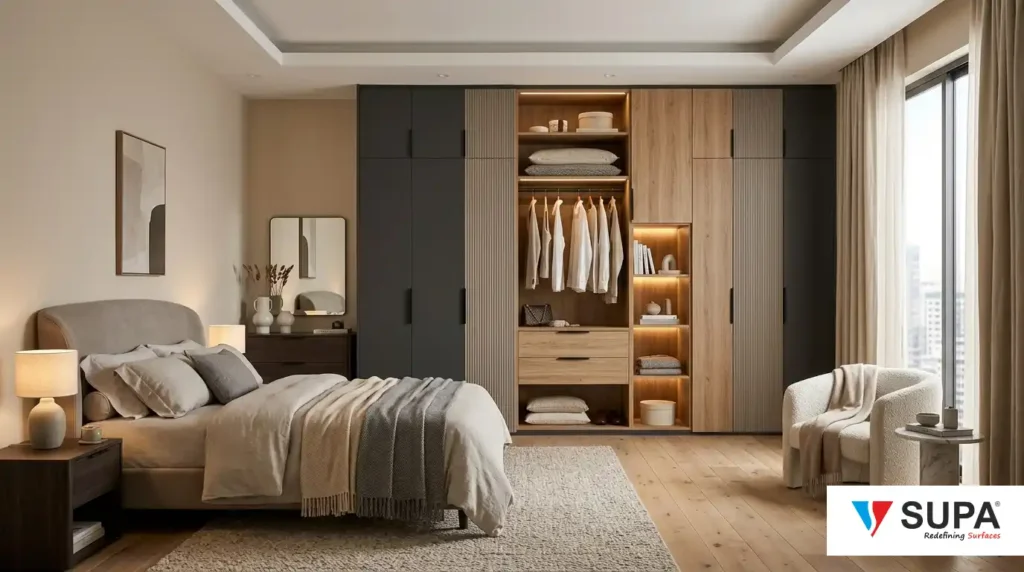
The wardrobe is usually the single largest furniture surface in a bedroom. How you finish it – the colour, the texture, the level of sheen – shapes how the entire room feels. Get it right and the wardrobe becomes the design anchor of the space. Get it wrong and it becomes the piece that everything else is trying to work around.
This guide covers what goes into a well-specified wardrobe laminate. It is useful whether you are a homeowner planning a renovation or a designer specifying materials for a client.
Why Laminates Are the Right Choice for Wardrobes
Wardrobes face more daily contact than almost any other piece of furniture in a home. Doors are opened and shut repeatedly. Shutter surfaces are touched constantly. Internal shelves carry weight continuously for years. Laminates handle this kind of sustained use reliably without the maintenance overhead that paint or veneer requires.
Compared to PU paint, laminates offer a much wider design palette and considerably less sensitivity to surface impact. Compared to veneer, they are more dimensionally stable in humidity-variable Indian conditions and significantly more affordable when you are covering large surface areas. For most wardrobe applications, a well-chosen laminate sheet is simply the most sensible specification.
Finish Options and When to Use Each
Matt and super matt laminates
The dominant wardrobe finish in 2026 residential projects. Matt finishes handle everyday fingerprints well, look premium in bedroom contexts, and work across virtually every colour palette. Super matt goes further with a velvety texture that creates a distinctly luxury feel. Both finish types work particularly well with handle-less push-to-open shutter designs where clean surface aesthetics are important.
High gloss laminates
Works well in contemporary master bedrooms with clean lines and minimal visual clutter. White gloss wardrobes in particular are a reliable choice for their light-reflective quality in smaller rooms. The practical trade-off is fingerprint visibility, so client expectations on maintenance frequency need to be set correctly upfront.
Wood finish laminates
A perennial choice for bedrooms where warmth and organic texture are the design priority. Teak, oak, walnut, and wenge grain laminates work beautifully on wardrobe exteriors, particularly when combined with simple hardware or push-to-open mechanisms that keep attention on the surface rather than the fittings.
Textured laminates
Linen weave, concrete grain, and fabric texture laminates are increasingly used for accent wardrobe panels or as feature elements within a larger wardrobe system. Textured surfaces add a depth of material quality that flat finishes cannot replicate and read particularly well in photography.
Colour Strategy by Room Type
| Bedroom Type | Recommended Colour Palette | Finish Recommendation |
|---|---|---|
| Small or compact bedroom | Soft white, warm beige, light grey | Matt or gloss to reflect available light |
| Master bedroom | Warm wood tones, deep navy, dusty sage green | Super matt or wood finish laminate |
| Children’s bedroom | Pastel or playful mid-tones | Scratch-resistant matt in a practical grade |
| Teenager’s room | Bold accent colour plus neutral base | Gloss accent panel with matt body |
| Guest bedroom | Calm neutrals, greige, oat, stone | Matt or subtle textured laminate |
| Studio apartment wardrobe | White or very light unified tone | Gloss for maximum light reflection |
Does Thickness Matter for Wardrobe Laminates?
For standard wardrobe shutter panels up to around 700 mm wide, 0.8 mm laminates perform well in most installations. For larger sliding doors, tall full-height shutters, or applications where heavy daily use is expected, 1 mm provides better edge stability and reduces the likelihood of sheet corners lifting over time.
The cost difference between 0.8 mm and 1 mm across a typical wardrobe project is relatively modest. On a high-value bedroom project, specifying 1 mm for the primary exterior surfaces is worth the small additional cost for the improved durability and finish longevity.
Interior vs Exterior: Use Different Finishes Deliberately
Many designers apply different laminates to wardrobe interiors and exteriors, and this is an approach worth considering. The exterior shutter gets the primary design finish, whether matt, gloss, or wood grain. Interior shelves and panels typically get a lighter, easy-clean surface in an off-white or neutral matt that is practical without competing visually with the external design.
Some clients genuinely appreciate when the wardrobe interior uses a contrasting finish against the exterior. Opening the door to a well-chosen interior surface adds a detail of craft that clients notice and remember. It also photographs well, which matters for portfolio documentation.
Coordinating Hardware with Your Laminate Choice
The laminate finish should inform the hardware specification rather than the other way around. Matt dark-toned laminates pair naturally with brushed brass or matte black handles. Gloss white wardrobes call for chrome or minimal recessed hardware. Wood finish laminates work best with warm-toned metals in brass or bronze. Supalam’s range across finishes and tones is broad enough that hardware coordination is a genuine creative decision rather than a compromise.
For the current range across wardrobe-relevant laminates, the Acryglem, Unitop, and Supa Lam series in the Supalam catalogue cover the primary finish categories.
Explore Supalam Wardrobe Laminates at supalam.com | Acryglem, Unitop, Supa Lam, Download e-Catalogue
Frequently Asked Questions
Which laminate finish works best for wardrobe shutters?
Matt and super matt finishes are the top choice for wardrobe shutters in 2026. They conceal fingerprints, look premium in bedroom settings, and work well with handle-less shutter designs. Gloss is a strong alternative when the brief specifically calls for a high-contrast contemporary look.
What thickness of laminate should be used for wardrobe doors?
1 mm laminates are the standard recommendation for wardrobe doors and wide shutter panels. They provide better edge integrity and a lower risk of delamination compared to 0.8 mm sheets on larger surfaces. For narrow panels and curved profiles, 0.8 mm is acceptable.
Can I use textured laminates inside the wardrobe?
Yes. A neutral textured laminate on wardrobe interior surfaces adds a sense of craft and attention to detail. A common and effective approach is a contrasting interior finish against the primary exterior – for example a warm wood grain inside against a matt dark exterior.
How do I choose laminate colours for a small bedroom wardrobe?
For smaller bedrooms, light neutrals, warm whites, and soft wood tones keep the space feeling open. Very dark finishes on large wardrobe panels in compact rooms can visually close the space down, so reserve darker tones for accent elements rather than the primary shutter finish.
Are standard HPL laminates suitable for sliding wardrobe doors?
Yes. Standard HPL laminates bond well to aluminium and MDF frames used in sliding wardrobe systems. Use 1 mm thickness on wider sliding panels for stability and ensure all edges are properly banded and sealed to prevent any lifting over time.