
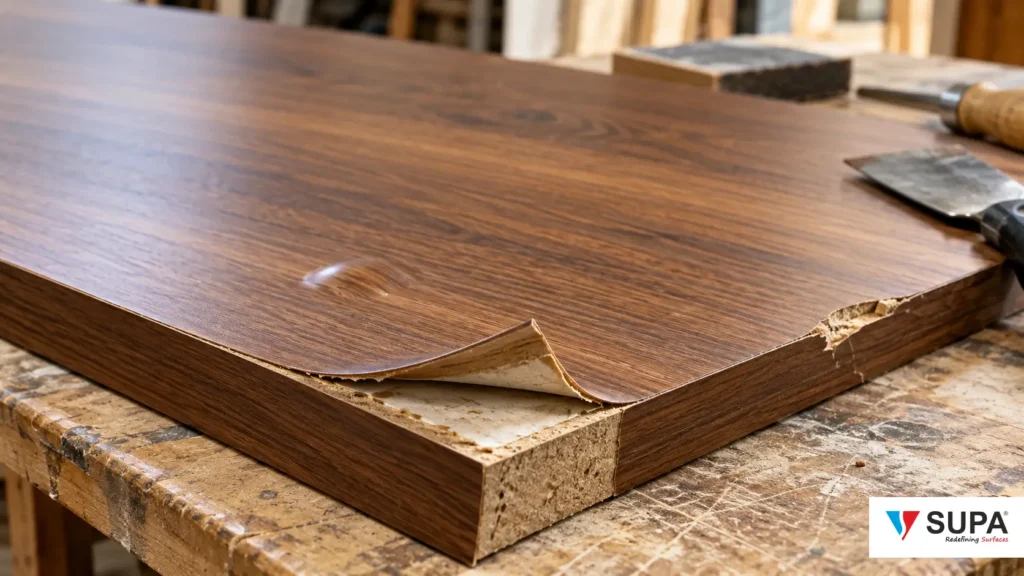
Laminate peels off when the bond between the sheet and the board fails, and that almost always traces back to adhesive, pressure or moisture at the edges. The sheet itself is rarely the cause. Find where the lifting started, at a corner, in the middle or along an edge, and you will know both the reason and whether it can be repaired.
Why does laminate lift at the corners and edges?
Laminate lifts at corners and edges because that is where adhesive coverage is thinnest and moisture gets in first. A corner is the hardest place to spread glue evenly and the easiest place to miss with pressure.
Four causes account for most cases:
- Too little adhesive near the edge. The brush or spreader runs dry as it reaches the border of the panel.
- Pressure that never reached the edge. Weights or clamps were placed in the middle, and the border was left to settle on its own.
- An exposed board edge. Without edge band, the cut edge of plywood or particle board takes in moisture, swells slightly and pushes the sheet up.
- Heat. Panels beside a hob, an oven housing or a sunny window go through daily heating and cooling, which works on a weak glue line until it lets go.
Lifting that starts within a few weeks of installation points to workmanship. Lifting that appears after years, on a kitchen base unit or a bathroom vanity, usually points to water reaching an unsealed edge.
What causes bubbles in the middle of a laminated panel?
Bubbles in the middle of a panel are caused by trapped air, trapped solvent or a patch with no adhesive. The sheet has bonded around the spot and not on it.
With contact adhesive, the usual mistake is timing. Both surfaces are coated and must be left until they are touch dry before they are brought together. Join them too early and solvent is sealed inside, where it expands and raises a blister. Join them too late and the adhesive has lost its grab. With white glue, the usual mistake is too little time under pressure, so the panel is moved before the bond has set.
Dust is the third cause. A board that was sanded and not wiped has a film of fine powder on it. The adhesive bonds to the powder, and the powder is not bonded to anything.
A quick test tells you what you have. Tap across the panel with a knuckle or a coin. A bonded area sounds solid. A hollow area sounds papery. Mark the edges of every hollow patch with pencil before you decide what to do.
Why do laminate edges chip?
Laminate edges chip because the sheet is hard and thin, and an unsupported edge takes every knock directly. A chip is damage to the sheet. It is different from peeling, where the sheet is intact and the bond has failed.
Chipping has three common sources. A blunt or wrong saw blade tears the edge during cutting and leaves small nicks that grow with use. A sheet that overhangs the board, even by a fraction, catches on sleeves, bags and cleaning cloths. And an edge with no edge band, or with a thin tape that has come loose, leaves the sheet's border exposed.
This is where edge band earns its place. A properly bonded band covers the border of the sheet, takes the impact and seals the board at the same time. Supalam makes Supa Edge Band in PVC and ABS, in 0.8mm, 1mm, 2mm and 3mm thicknesses, so a thicker band can be chosen for the edges that take the most abuse, such as drawer fronts and base unit shutters. See the Supa Edge Band range for widths and finishes.
Diagnose the problem from the symptom
Match what you see to the likely cause before anyone reaches for glue. The table covers the cases that come up most on site.
| What you see | Most likely cause | Can it be repaired? | How to prevent it |
|---|---|---|---|
| Corner lifting on a new shutter | Thin adhesive or no pressure at the edge | Yes, if caught early | Coat to the edge, press the borders |
| Edge lifting near sink or floor | Water entering an unsealed board edge | Sometimes. Check the board for swelling | Edge band every cut edge |
| Blister in the middle of a panel | Trapped air or solvent, or a dry patch | Small ones, sometimes | Correct open time, roll from centre out |
| Hollow sound over a wide area | Dusty board or adhesive past its open time | Usually replace | Clean the board, bond in time |
| Chips along an edge | Rough cutting, overhang or missing edge band | Minor chips can be filled or covered | Sharp blade, flush trim, edge band |
| Sheet lifting beside the hob | Heat cycling on a weak glue line | Re-bond, then shield from heat | Keep clearance from heat sources |
| Whole panel bowed | Sheet on one face only | No. Remake the panel | Laminate both faces |
Can peeling laminate be pasted back?
Yes, peeling laminate can be pasted back when the sheet is undamaged, the board is dry and sound, and the lifted area is small. Outside those three conditions, a repair is usually temporary.
For a lifted corner or edge, the method is straightforward:
- Lift the loose section gently, only as far as it comes freely. Forcing it will crack the sheet.
- Clean out old adhesive and dust from both surfaces with a thin blade and a dry brush.
- Check the board. If it is soft, swollen or crumbling, stop. The board needs replacing.
- Apply fresh adhesive to both surfaces and follow the open time on the pack.
- Press the sheet down from the bonded side toward the edge to push air out.
- Clamp with a flat block over the area, or weight it, for the time the adhesive needs.
- Seal the edge with edge band once the bond has set.
Replace the panel instead of repairing it when the board has swollen, when the sheet has cracked, or when more than a small part of the face sounds hollow. A shutter is a single panel, and remaking one costs less than repairing it twice.
How do you stop it happening on the next job?
You prevent peeling and bubbling by controlling five things: the board, the adhesive, the timing, the pressure and the edges.
- Board. Use a flat, dry, clean substrate. Wipe off sanding dust. Do not laminate a board that has been stored against a damp wall.
- Adhesive. Use an adhesive made for decorative laminate, and enough of it. Coat right up to the edges.
- Timing. Respect the open time for contact adhesive and the setting time for white glue.
- Pressure. Roll or press from the centre outward so air escapes. Give the borders as much attention as the middle.
- Edges. Seal every cut edge, including the ones at the back and bottom that nobody sees.
Supalam covers the pasting sequence step by step in its guide on how to apply laminate on furniture. For carcass panels, a factory-finished surface removes site pasting from the equation altogether. Supalam supplies pre-lam boards for that purpose, leaving only cutting and edge banding to be done on site.
Is it the laminate or the workmanship?
In most cases it is the workmanship or the conditions, not the sheet. A decorative laminate is a stable, pressed product. It does not come apart on its own, and it cannot hold itself to a board that was dusty, damp or badly glued.
There are fair questions to ask about the sheet, though. Was it the thickness that was specified? A thinner sheet on a high-contact shutter will show wear and edge damage sooner. Our guide on how to check laminate thickness explains how to confirm it. Was it stored flat and dry before use? And was a matching edge band used, or a thin tape from another source?
If a defect appears across several panels from the same lot, keep an offcut with the back print and the decor code, photograph the problem and take it to the dealer. Those two details are what a manufacturer needs to trace a batch. For day-to-day upkeep once the furniture is sound, the basics in Edge Banding 101 and a gentle cleaning routine will keep edges and faces in good order. When you are choosing sheets for the next project, start with the 1mm decorative laminates range for the faces that work hardest.
Frequently Asked Questions
Why is my sunmica coming off the plywood?
The bond has failed, usually because of too little adhesive, poor pressure at the edges or moisture entering an unsealed board edge. Check where the lifting began. A corner or edge points to glue and sealing. A patch in the middle points to trapped air or dust.
How do you fix bubbles in laminate?
Small bubbles near an edge can sometimes be re-bonded by lifting the sheet, adding adhesive and pressing. Bubbles in the middle of a panel are hard to fix invisibly. If a wide area sounds hollow when tapped, replacing the panel is the reliable fix.
Can I glue laminate back with any adhesive?
No. Use an adhesive made for decorative laminate and follow its open time and pressing instructions. General-purpose glues and instant adhesives give a brittle or patchy bond that fails again.
Does edge band stop laminate from peeling?
It helps a great deal. Edge band seals the board edge against moisture and protects the border of the sheet from knocks. It does not make up for poor adhesive coverage, so both steps matter.
How long should laminate stay under pressure after pasting?
Follow the adhesive manufacturer's instructions, because setting time varies by product and by weather. Do not move, cut or hang a panel until the bond has fully set. Rushing this step is a common cause of early lifting.
Fix the cause, not just the corner
Protect every edge with Supa Edge Band, consider pre-lam boards for carcass work, and see the e-catalogue for matching designs. For product guidance, contact the team.