
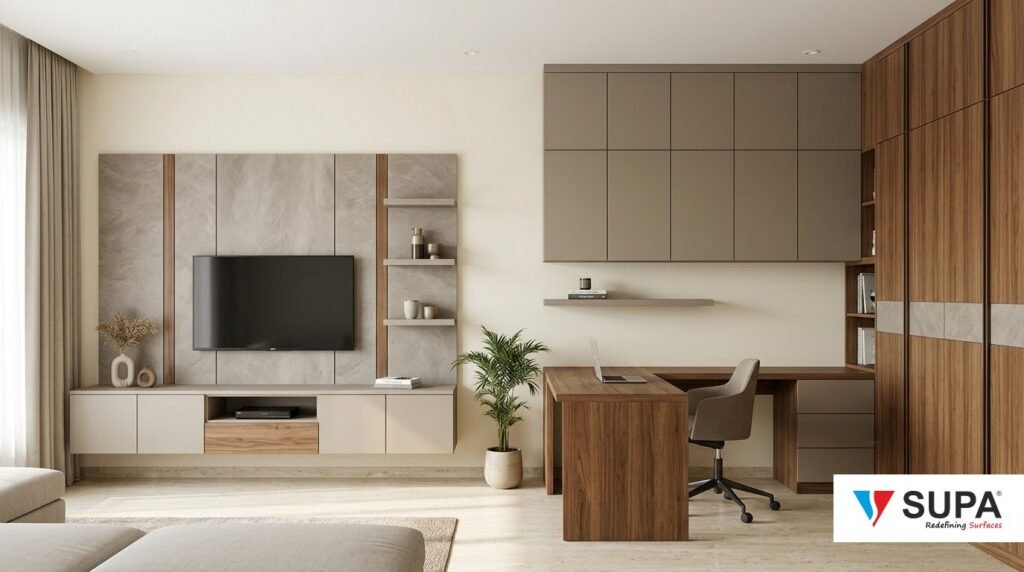
Supa Unitop is Supalam’s core high-pressure laminate line, built as the everyday workhorse range that covers the majority of standard furniture and interior surfacing needs.
Where Acryglem is the premium acrylic-finish tier, Unitop is the range most modular kitchens, wardrobes and office furniture actually get built from. It offers standard HPL performance across a wide finish and colour library at a price point suited to full-home projects.
Knowing what sits inside the Unitop range makes it easier to specify the right sheet the first time, rather than over- or under-buying for a given surface.
Because Unitop is the range most dealers and carpenters reach for by default, understanding its thickness and finish structure in advance puts you in a much stronger position when reviewing a quote or a bill of materials for a full home project.
It’s also the range that gives the clearest picture of what a laminate brand is actually capable of, since it’s produced at far higher volumes than any premium tier and has to hold consistent quality across every batch. A brand whose standard, everyday range performs reliably is usually a safer bet across its entire catalogue than one that only showcases its premium line while leaving quality on the everyday range inconsistent.
Unitop Covers Both 0.8mm and 1mm Thickness for Different Surface Needs
The Unitop range is built around the two thicknesses that cover almost every standard furniture application: 0.8mm for vertical, lower-contact surfaces like wardrobe interiors and cabinet backs, and 1mm for higher-contact surfaces like shutters, doors and tabletops that need the extra rigidity and impact resistance.
This two-thickness structure lets a single project source everything from one range rather than switching between multiple product lines for different parts of the same wardrobe or kitchen.
A Wide Finish Range Makes Unitop Suitable for Almost Any Room
Unitop spans the standard finish categories, including matte, suede, gloss, textured and wood grain, which is what makes it the default recommendation for full-home projects rather than a single-application product. A kitchen, a set of wardrobes and an office workstation on the same order can all be specified from within Unitop without needing a separate premium line.
This breadth is also why Unitop tends to be the range dealers reach for first when a client hasn’t yet specified a premium finish preference. It covers the practical middle ground that suits most budgets and most rooms.
Where Unitop Fits Against Supalam’s Other Product Lines
Unitop is the general-purpose range. Acryglem is the acrylic premium-finish upgrade for feature surfaces, and the prelaminated board and particle board lines cover projects that need factory-bonded panels rather than standalone sheets. Most full-home or commercial projects end up combining two or more of these lines rather than using just one throughout.
For a straightforward modular kitchen or wardrobe brief with no specific premium-finish requirement, Unitop is typically the starting recommendation, with Acryglem introduced only where a specific feature surface calls for the extra shine.
How to Order the Right Unitop Sheets for a Multi-Room Project
The most reliable way to plan a Unitop order across a full home is to work room by room rather than trying to estimate total sheet count in one pass. List every shutter, panel and interior surface per room, note which thickness each one calls for, and group the order by finish so that colour-matched batches stay together.
It’s also worth over-ordering slightly, by roughly five to ten percent, on any finish or colour that’s difficult to source again later, since minor batch variations between production runs can be noticeable if a shortfall means topping up mid-project. Dealers working from Supalam’s e-catalogue can usually confirm current shade availability before finalising quantities, which avoids the common problem of discovering a colour is out of stock only after installation has already started.
Maintenance and Lifespan of Unitop Laminate Surfaces
Unitop’s standard HPL construction is built for years of daily use with only routine care. A damp cloth and mild household cleaner are sufficient for most finishes, and matte and textured surfaces in particular are forgiving of everyday wear since they don’t show fingerprints or light scuffing the way a gloss finish would.
With reasonable care, Unitop shutters and panels typically hold their finish well beyond a decade, and since the range is factory-consistent, replacing a single damaged panel later on is usually straightforward as long as the original shade code was recorded at the time of purchase.
Unitop vs Generic Market Laminate: What the Price Difference Buys You
Unregulated, unbranded laminate is often sold at a noticeably lower price point in the open market, and on paper it can look like an easy way to cut costs on a large order. The difference usually shows up within the first year or two rather than at the point of purchase, in the form of uneven colour batches, thinner-than-specified sheets, or a resin layer that yellows faster under normal indoor light exposure.
Because Unitop is manufactured to a consistent factory specification, dealers and carpenters can rely on a given shade code matching exactly across separate orders placed months apart, something that’s far less certain with generic market laminate sourced from varying, unbranded production runs. For any project where colour consistency across a full room, or a top-up order after initial installation, matters to the final result, that consistency is where the price difference over generic laminate is actually recovered.
There’s also a documentation advantage that’s easy to overlook until it’s needed. Unitop’s specification sheets, thickness tolerances and finish codes are recorded and available through Supalam’s e-catalogue, which matters when a client, architect or interior designer needs to confirm exact material specifications for a project handover or a warranty claim. Generic market laminate rarely comes with that same level of traceable documentation, which can become a real problem if a dispute or a quality issue arises after installation and there’s no clear paper trail back to the original product specification.
At a Glance: Comparison Table
| Spec | Supa Unitop 0.8mm | Supa Unitop 1mm |
|---|---|---|
| Best use | Wardrobe interiors, cabinet backs, low-contact vertical surfaces | Shutters, doors, tabletops, higher-contact surfaces |
| Rigidity | Standard | Higher, better impact resistance |
| Finish options | Matte, suede, gloss, textured, wood grain | Matte, suede, gloss, textured, wood grain |
| Typical application | Full wardrobe carcass interiors | Wardrobe and kitchen shutter faces |
Frequently Asked Questions
What is Supa Unitop used for?
Unitop is Supalam’s general-purpose high-pressure laminate range, used across wardrobes, modular kitchens and office furniture wherever standard HPL performance is needed rather than a premium acrylic finish.
Should I choose 0.8mm or 1mm Unitop for my wardrobe?
Use 0.8mm for interior surfaces like cabinet backs and shelving that see limited contact, and 1mm for the shutter faces and doors that get handled and need better impact resistance.
Does Unitop come in gloss and matte finishes?
Yes. Unitop spans the full standard finish range including matte, suede, gloss, textured and wood grain, so most design briefs can be sourced from within this one range.
Is Unitop cheaper than Supa Acryglem?
Yes. Unitop is the standard HPL range, while Acryglem is a premium acrylic-finish upgrade, so Unitop is the more budget-friendly choice for full-home coverage.
Can Unitop be used for kitchen shutters?
Yes, 1mm Unitop is a common choice for kitchen shutter faces, offering the rigidity and finish range needed for a modular kitchen without moving up to the acrylic premium tier.
See the full Supa Unitop thickness and finish options in the Supalam e-catalogue, or view the complete laminate product range.