
Walk into any carpenter’s workshop or building materials shop in India and ask for a laminate sheet. There is a good chance the carpenter will call it Sunmica. Ask the same question in Delhi or Ahmedabad and you will hear different names depending on who you are talking to Sunmica, formica, laminate sheet, or simply mica. These names mean different things to different people, yet they often describe exactly the same material.
This confusion costs buyers money and leads to specification errors. Understanding what Sunmica actually is, how it differs from other laminate types, and which product is right for your project is the kind of clarity this guide provides.
If you are a homeowner planning a kitchen renovation, a designer specifying materials for a residential project, or a contractor sourcing sheets in bulk, the information here will help you make a better decision and avoid the most common mistakes.
What Is Sunmica and Why Does Everyone Call It That?
Sunmica is a brand name, not a material. It was one of the first decorative laminate brands to achieve mass distribution in India, originally under Bombay Burmah Trading Corporation and later acquired by AICA Laminates India. The brand was so widely distributed that carpenters, dealers, and homeowners began using ‘Sunmica’ as a generic term for any decorative laminate sheet in the same way people say ‘Xerox’ for any photocopy or ‘Colgate’ for any toothpaste.
The result of this brand genericisation is that most people in India who say ‘Sunmica’ are actually referring to a decorative high-pressure laminate (HPL) sheet in general. The specific Sunmica brand by AICA is just one manufacturer among dozens operating in the Indian market today.
So when someone asks ‘Sunmica vs laminate’ they are, in most cases, really asking: ‘should I use a well-known brand name sheet or a lesser-known brand sheet?’ The material in both cases is the same category of product: a decorative HPL sheet made under heat and pressure from kraft paper, resin, and a printed decorative layer.
How Decorative Laminate Sheets Are Actually Made
Every standard decorative laminate regardless of brand is manufactured through the same high-pressure process. Multiple layers of kraft paper are saturated with melamine resin. A printed decorative layer is placed on top with a protective overlay. The entire stack is pressed under temperatures exceeding 120 degrees Celsius and pressure above 70 kilograms per square centimetre. The result is a hard, dense sheet that is dimensionally stable, moisture resistant, and surface-hardened.
This process is defined by the Bureau of Indian Standards under IS 2046:1995, the specification that governs decorative laminate sheets in India. Any laminate sheet claiming to meet IS 2046 has been produced to this standard, regardless of whether it carries the Sunmica name, the Greenlam name, or the Supalam name.
Where manufacturers differentiate is in the quality of raw materials, the resolution and depth of the decorative print, the press temperature and duration, the overlay thickness, and the surface finish applied. These variables determine the actual performance difference between a Rs 30/sq ft sheet and a Rs 120/sq ft sheet not the brand name on the packaging.
Types of Laminates Available in India: Beyond the Basic Sheet
| Laminate Type | Thickness | Best Application | Price Range (per sq ft) |
|---|---|---|---|
| Standard HPL (General Purpose) | 0.8mm | Light-use furniture, back panels, shelves | Rs 25-50 |
| Premium HPL (1mm) | 1mm | Wardrobe shutters, TV units, study tables | Rs 45-90 |
| High Performance 1mm+ | 1mm+ | Kitchen shutters, high-traffic surfaces | Rs 80-130 |
| Acrylic Finish Laminate | 1mm+ | Premium kitchens, reception counters | Rs 100-250+ |
| Digital Print Laminate | 1mm+ | Feature walls, custom designs, hospitality | Rs 150-400+ |
| Compact HPL (exterior/wet areas) | 6mm-12mm | Toilet partitions, laboratory tops | Rs 250-600+ |
The table above covers the main laminate categories available in the Indian market in 2026. What most homeowners call ‘Sunmica’ typically refers to the standard HPL or premium HPL tier. Premium ranges from manufacturers like Supalam expand well beyond this into acrylic-finish, digital print, and high-performance surfaces that the generic Sunmica reference does not capture.
Sunmica vs Premium Laminate Brands: The Actual Performance Differences
For buyers who are comparing the original Sunmica product (by AICA) against other laminate brands in the market, here is what the real differences look like in practice.
| Parameter | Standard Sunmica / Generic Sheet | Premium Laminate (e.g. Supalam range) |
|---|---|---|
| Surface hardness | Adequate for light use | Higher engineered for kitchen and heavy-use applications |
| Colour consistency across batches | Variable batch matching is a known issue | Maintained with decor code system across production runs |
| Design range | Standard woodgrains and solids, limited textures | Hundreds of designs including deep textures, digital prints, metallic |
| Edge band availability | Usually sourced separately, colour matching unreliable | Matching edge band available per decor code |
| Moisture resistance grade | Standard MR (Moisture Resistant) | MR and high-performance grades available |
| Acrylic/gloss finish options | Limited | Full acrylic-level gloss available (e.g. Supa Acryglem range) |
| IS 2046 compliance | Typically yes | Yes, with additional performance certifications |
The most operationally significant difference is colour consistency across batches. A designer or contractor who specifies a particular woodgrain for a project running over two months needs the second batch ordered to match the first. With unbranded or commodity sheets, this match is unreliable. With a manufacturer that maintains decor codes across production runs, it is a guarantee.
Where the ‘Sunmica vs Laminate’ Question Actually Matters
For Kitchen Cabinets
A kitchen is the highest-stress environment for any surface in a home. Daily exposure to heat, oil splatter, cleaning chemicals, and physical contact demands a surface that is genuinely engineered for this use not just any HPL sheet. The difference between a general-purpose 0.8mm sheet and a kitchen-grade 1mm+ laminate is real in this context.
Generic Sunmica sheets used on kitchen shutters often show surface wear, micro-scratches, and stain absorption within three to five years of daily use in an active Indian kitchen. Kitchen-grade laminates from specialist manufacturers are formulated with harder overlay coatings and higher-density substrates specifically for this application.
For kitchens, brand name matters less than the specific product grade. Look for explicitly kitchen-rated laminates rather than general decorative sheets at any price point.
For Wardrobes and Bedroom Furniture
Wardrobes are opened and closed hundreds of times per year. The shutter edges take repetitive stress at hinge and handle points. For wardrobes, a 1mm HPL with proper MDF substrate and matched edge band is the right specification. A 0.8mm sheet applied without edge band protection will show edge chipping within two to three years at hinge points.
The surface finish choice for wardrobes depends on bedroom orientation and maintenance preference. Matte finishes on wardrobe shutters are the most practical specification for most Indian bedrooms because they do not show fingerprints and dust the way gloss surfaces do. A gloss or acrylic-finish panel used as a single accent door is a better application of high-gloss laminates than covering an entire wardrobe.
For Living Room Furniture and TV Units
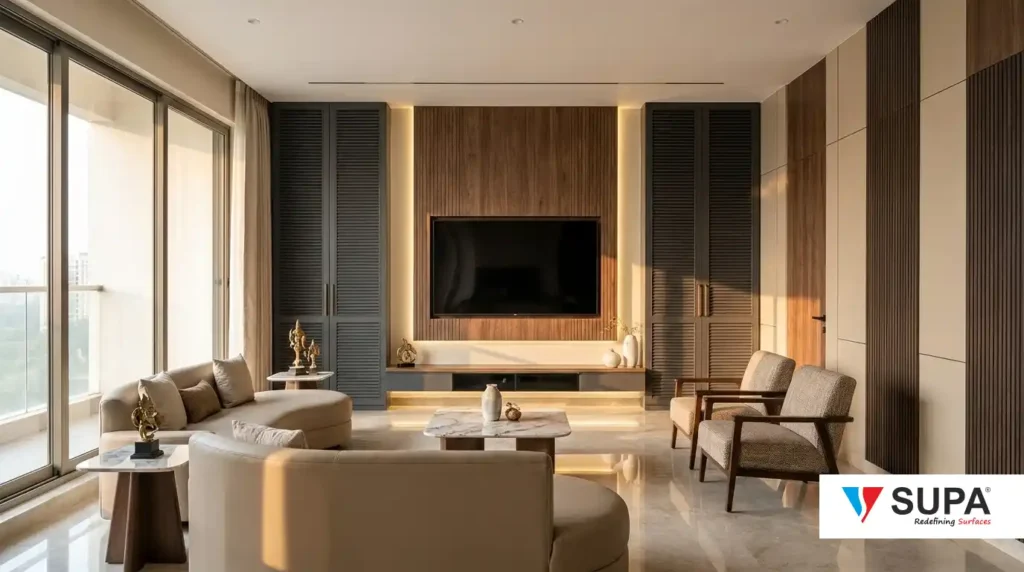
TV units and entertainment units see less physical contact than kitchens or wardrobes. For these applications, the design range matters more than the performance specification. This is where digital print laminates, stone textures, and premium woodgrains justify their higher price the piece is a visual focal point and it is not subject to the same mechanical stress as a kitchen shutter.
How to Identify a Quality Laminate Sheet Regardless of Brand Name
Whether you are sourcing a premium brand or a mid-range sheet, these are the checks that distinguish quality product from commodity:
- Check the back of the sheet for the manufacturer name, IS 2046 certification mark, thickness specification, and decor code. A quality sheet carries all of this information printed clearly on the brown kraft backing.
- Verify the surface hardness by pressing a fingernail firmly across the surface. A quality overlay leaves no mark. A substandard sheet will show a faint scratch line.
- Check the edges of the sheet for delamination. On a quality sheet, the layers are fully fused and the edge cross-section is solid. On a poorly pressed sheet, the layers can be partially separated or visible as distinct layers at the edge.
- Request a water resistance test: place a drop of water on the surface and leave for two minutes, then wipe. The surface should show no absorption mark or discolouration. Any darkening indicates moisture ingress and inadequate overlay.
- For colour consistency, always ask to see sheets from the same production batch when ordering for a full project. Reputable manufacturers will provide batch numbers on the backing.
The Most Common Mistakes Buyers Make When Choosing Laminates
Based on the most frequent errors seen in the Indian furniture and interiors market:
- Specifying 0.8mm sheets for kitchen shutters to save cost. The saving on material is typically Rs 5-10 per sq ft. The cost of replacement within five years is significantly higher.
- Buying sheets without checking for matching edge band. The edge finish is what fails first on any laminate furniture. Colour-matched edge band from the same manufacturer is not optional.
- Ordering all sheets at the start of a project without confirming batch availability for later phases. Large residential or commercial projects that span months need confirmed batch-consistent supply.
- Confusing ‘acrylic laminate’ and ‘acrylic shutter.’ Acrylic shutters are pure PMMA plastic applied over MDF. Acrylic-finish laminates are HPL sheets with a high-gloss overlay. They look similar but the performance and installation characteristics are different.
- Using general decorative laminates on door skins. Door applications require specific door-grade laminates that flex without delaminating during the press bonding process. Standard furniture-grade HPL is the wrong specification for doors.
Frequently Asked Questions
Q1. Is Sunmica the same as laminate?
Sunmica is a brand of decorative laminate manufactured by AICA Laminates India. Over decades of distribution, the name became a generic term in India for any laminate sheet. Technically, Sunmica is one brand within the broader laminate category, not a separate material. When carpenters or dealers say ‘Sunmica,’ they almost always mean a standard decorative HPL sheet, regardless of who made it.
Q2. Which laminate thickness is best for kitchen cabinets?
For kitchen shutters, a minimum of 1mm HPL is recommended. Kitchen-rated 1mm+ laminates with harder overlay coatings are the better specification for lower cabinets and any shutter within the cooking zone. The 0.8mm thickness is appropriate for upper cabinet internals, back panels, and areas that see minimal direct contact.
Q3. How long does laminate furniture last in Indian conditions?
A properly specified and installed 1mm HPL laminate on a quality MDF or plywood substrate with sealed edge band will last 10 to 15 years under normal residential use. The limiting factor is almost always the edge treatment, not the surface. Unsealed or poorly matched edge band fails well before the surface laminate shows wear.
Q4. What is the difference between HPL and LPL?
High-Pressure Laminate (HPL) is a standalone sheet manufactured under high heat and pressure, then bonded to a substrate during furniture fabrication. Low-Pressure Laminate (LPL), also called pre-laminated board, has the decorative surface fused directly onto MDF or particle board at the factory. HPL is harder, more durable, and available in more finishes. Prelam boards (LPL) are more economical for applications like internal shelves, carcass construction, and back panels where surface performance is less critical.
Q5. Can laminate be used in bathrooms?
Standard decorative laminates are moisture resistant but not waterproof. Prolonged exposure to standing water or continuous humidity in a bathroom will eventually cause delamination at edges and joints. For bathroom vanity tops, compact HPL (6mm+) is the appropriate product. For bathroom cabinet shutters with limited direct water contact, standard 1mm MR-grade laminates with fully sealed edges perform adequately in most Indian bathroom conditions.
Q6. What is the standard laminate sheet size in India?
The standard size for decorative laminate sheets in India is 8 feet by 4 feet (approximately 244cm by 122cm), providing approximately 32 square feet per sheet. Some manufacturers offer 8×3 and 10×4 sizes for specific applications. When calculating project requirements, always add 10 to 15 percent for cutting wastage and pattern matching.
Q7. How do I tell a genuine IS 2046 certified laminate from a substandard sheet?
A genuine IS 2046 certified laminate sheet will carry the BIS (Bureau of Indian Standards) mark printed on the backing, along with the manufacturer’s name, address, IS 2046 designation, and the sheet’s technical specification code. Check for the BIS licence number which can be verified directly on the BIS portal. Sheets sold loose without backing information or without a manufacturer address printed on them have no verifiable certification chain.