
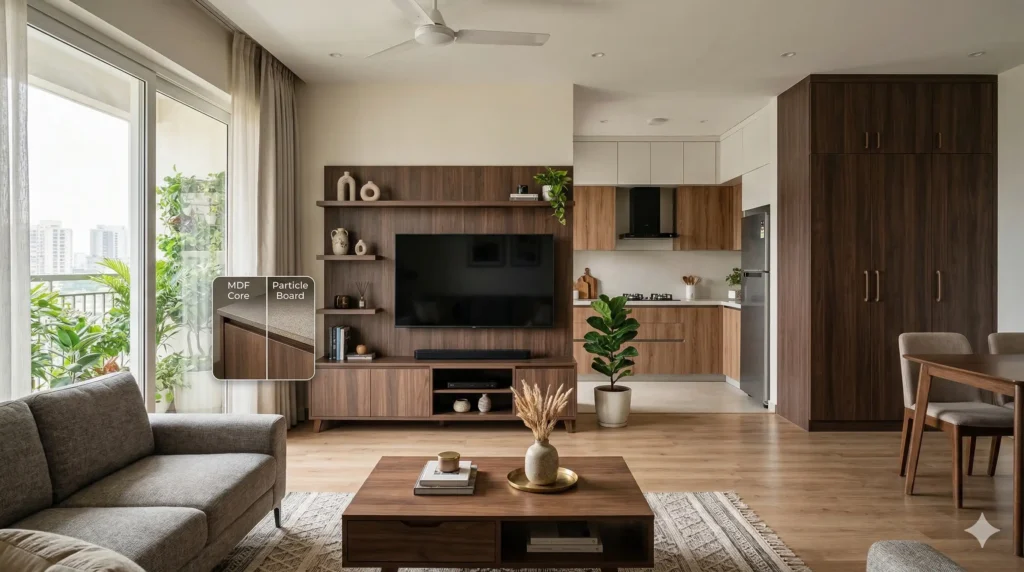
When designing custom furniture or renovating your home, one of the most crucial decisions is selecting the right board material. While many homeowners focus solely on the decorative laminate finish, the substrate board beneath it significantly impacts your furniture’s durability, functionality, and longevity.
Two popular options dominate the Indian furniture market: Prelam MDF (Medium Density Fiberboard) and Prelam Particle Board. Both come pre-laminated from the factory, offering convenience and cost savings, but they have distinct characteristics that make each suitable for different applications.
This comprehensive guide will help you understand the differences, advantages, and ideal uses for each material, ensuring you make an informed decision for your furniture projects.
Understanding Board Materials
Before comparing, let’s understand what these materials actually are.
What is MDF (Medium Density Fiberboard)?
Composition:
- Fine wood fibers
- Resin and wax binders
- Manufactured under high heat and pressure
- Uniform density throughout
Manufacturing Process:
- Wood logs are broken down into fine fibers
- Fibers are mixed with resin adhesive
- Mixture is pressed under high pressure and heat
- Results in smooth, uniform boards
Characteristics:
- Very smooth surface
- Uniform density
- No grain direction
- Easy to machine and cut
- Heavier than particle board
What is Particle Board?
Composition:
- Wood chips, shavings, and sawdust
- Resin binders
- Pressed under heat and pressure
- Denser in outer layers, less dense in core
Manufacturing Process:
- Wood waste materials are collected and processed
- Mixed with adhesive resin
- Arranged in layers (fine particles outside, coarse inside)
- Hot pressed into boards
Characteristics:
- Textured surface
- Three-layer structure
- Lighter than MDF
- More economical
- Adequate strength for most furniture
What is “Prelam”?
Prelam means pre-laminated – the decorative laminate is applied to the board at the factory, not by the carpenter during installation.
Advantages of Prelam Boards:
- Better quality control (factory lamination)
- Stronger adhesion
- More uniform finish
- Cost-effective (bulk production)
- Time-saving during installation
- Professional appearance
Types Available:
- Single-sided prelam (one side laminated)
- Double-sided prelam (both sides laminated)
- Various thickness options
- Multiple color and design choices
Detailed Comparison: Prelam MDF vs Prelam Particle Board
Physical Properties
Prelam MDF:
- Density: 720-920 kg/m³
- Weight: Heavier (approximately 30% more than particle board)
- Structure: Uniform throughout
- Surface: Very smooth, ideal for lamination
- Edges: Smooth, easy to finish
Prelam Particle Board:
- Density: 600-800 kg/m³
- Weight: Lighter, easier to handle
- Structure: Layered (fine outside, coarse inside)
- Surface: Slightly textured (covered by laminate)
- Edges: Rougher, requires edge banding
Impact: Density affects strength, screw-holding capacity, and durability.
Strength and Durability
Prelam MDF:
Advantages:
- Higher bending strength
- Better resistance to warping
- More uniform strength in all directions
- Superior edge strength
- Holds shape better under stress
Screw-Holding Capacity:
- Excellent for first installation
- May loosen if screws are removed and reinstalled multiple times
- Pre-drilling recommended for best results
- Good for hinge installation
Load-Bearing:
- Handles moderate to heavy loads well
- Suitable for shelves with books
- Good for countertops with appliances
Prelam Particle Board:
Advantages:
- Adequate strength for most furniture
- Good for light to moderate loads
- Cost-effective durability
- Sufficient for standard applications
Screw-Holding Capacity:
- Good initial hold
- Degrades faster with screw removal
- Edges are weaker than MDF
- Special screws recommended for better hold
Load-Bearing:
- Suitable for light to moderate loads
- Good for clothing storage
- Adequate for TV units (with proper support)
- May sag over time with heavy books
Verdict: MDF offers superior strength and durability; particle board adequate for most standard uses.
Moisture Resistance
Prelam MDF:
Standard MDF:
- Absorbs water like a sponge
- Swells significantly when wet
- Difficult to restore after water damage
- Not suitable for humid areas
Moisture-Resistant MDF:
- Special additives resist moisture
- Green core indicates moisture resistance
- Better for bathrooms and kitchens
- Costs 20-30% more than standard MDF
Prelam Particle Board:
Standard Particle Board:
- Moderate moisture absorption
- Swells at edges primarily
- Core less affected than MDF
- Recoverable from minor water exposure
Moisture-Resistant Particle Board:
- Better resistance than standard version
- Still requires careful use in wet areas
- Good for Indian kitchens (with proper sealing)
Critical Note: Regardless of type, always:
- Seal all edges properly
- Clean spills immediately
- Avoid direct water contact
- Use moisture-resistant versions in kitchens/bathrooms
Verdict: Both absorb moisture; MDF more severely. Choose moisture-resistant variants for wet areas.
Workability and Machinability
Prelam MDF:
Cutting:
- Cuts very smoothly
- Clean edges
- No splintering
- Can achieve intricate designs
Drilling:
- Drills cleanly
- Pre-drilling unnecessary for most screws
- Can drill close to edges
Routing and Shaping:
- Excellent for decorative edges
- Smooth curves possible
- Can create detailed profiles
Finishing:
- Edges can be painted or edge-banded easily
- Smooth surface ideal for painting
- Takes veneer well
Prelam Particle Board:
Cutting:
- Cuts adequately
- Some edge roughness
- May chip if not careful
- Requires sharp blades
Drilling:
- Drills well with proper bits
- More prone to edge breakage
- Careful near edges required
Routing and Shaping:
- Limited decorative routing
- Edges may crumble
- Simple shapes work best
Finishing:
- Edge banding essential
- Rougher edges than MDF
- Laminate covers surface imperfections
Verdict: MDF is significantly easier to work with, especially for custom designs.
Cost Comparison
Prelam MDF (2026 Market Prices):
Standard MDF:
- 8mm thickness: ₹55-70 per sq ft
- 12mm thickness: ₹75-95 per sq ft
- 18mm thickness: ₹95-120 per sq ft
- 25mm thickness: ₹140-170 per sq ft
Moisture-Resistant MDF:
- Add 20-30% to above prices
Prelam Particle Board (2026 Market Prices):
Standard Particle Board:
- 8mm thickness: ₹40-55 per sq ft
- 12mm thickness: ₹55-70 per sq ft
- 18mm thickness: ₹70-90 per sq ft
- 25mm thickness: ₹100-130 per sq ft
Cost Difference: Particle board is approximately 25-30% cheaper than MDF
Example – 10×10 Modular Kitchen:
- MDF: ₹35,000-45,000 (for boards)
- Particle Board: ₹25,000-32,000 (for boards)
- Savings with Particle Board: ₹10,000-13,000
Value Consideration: MDF’s durability may offset higher initial cost over time.
Environmental Impact
Prelam MDF:
Positive Aspects:
- Uses wood waste (sustainable)
- Efficient use of resources
- Recyclable
Concerns:
- Higher resin content = more formaldehyde
- Heavier (more transport emissions)
- Energy-intensive manufacturing
Look For: E0 or E1 certification for low formaldehyde
Prelam Particle Board:
Positive Aspects:
- Uses sawmill waste
- Highly sustainable
- Lower energy manufacturing
- Lighter (less transport emissions)
Concerns:
- Still contains formaldehyde in resins
- Shorter lifespan may mean more frequent replacement
Look For: E1 or better certification
Verdict: Both are relatively sustainable; particle board slightly better environmentally.
Application-Specific Recommendations
When to Choose Prelam MDF
Essential for:
1. Kitchen Cabinets
- Why: Better moisture resistance (if using MR grade)
- Superior screw-holding for hinges
- Smoother finish for painting
- Better durability in high-use areas
2. Bathroom Vanities
- Why: Moisture-resistant MDF handles humidity better
- Smooth surfaces easy to clean
- Doesn’t deteriorate as quickly in damp conditions
3. Intricate Designs
- Why: Easy to route and shape
- Clean edges for decorative profiles
- Ideal for designer furniture
4. Painted Furniture
- Why: Smooth surface provides excellent paint base
- No grain or texture shows through
- Professional painted finish achievable
5. High-End Projects
- Why: Premium feel
- Better longevity
- Superior finish quality
6. Heavy-Duty Shelving
- Why: Better load-bearing capacity
- Less sagging over time
- Stronger for books and heavy items
Prelam MDF Best Applications:
- Kitchen cabinets (with MR-MDF)
- Bathroom furniture
- Designer wardrobes with profiles
- Painted furniture
- Office desks and tables
- Premium projects
- Display units with decorative edges
When to Choose Prelam Particle Board
Ideal for:
1. Bedroom Wardrobes
- Why: Adequate strength for clothing
- Cost-effective for large wardrobes
- Lighter (easier installation)
- Sufficient durability
2. Office Furniture
- Why: Good for light to moderate use
- Cost-effective for corporate projects
- Easy to replace if needed
- Adequate strength
3. TV Units
- Why: Handles TV weight with proper support
- Good for storing lighter items
- Cost savings significant
4. Budget Projects
- Why: 25-30% cost savings
- Adequate quality for most uses
- Good value proposition
5. Temporary or Rental Properties
- Why: Lower investment
- Adequate lifespan for rental duration
- Easy to replace
6. Retail Displays
- Why: Cost-effective for commercial use
- Easy to modify or replace
- Sufficient for display purposes
Prelam Particle Board Best Applications:
- Bedroom wardrobes and storage
- Office cabinets and desks
- TV units and entertainment centers
- Retail shelving and displays
- Budget furniture projects
- Rental property furniture
- Guest room furniture
Room-by-Room Guide
Kitchen:
- Cabinets: MR-MDF (moisture resistance crucial)
- Countertop Base: MDF or thick particle board
- Shelves: MDF (better for weight)
- Shutters: Either (depends on budget)
Bedrooms:
- Wardrobe Carcass: Particle board (cost-effective)
- Wardrobe Shutters: MDF if decorative, particle board if plain
- Study Table: MDF (better durability)
- Side Tables: Either works
Living Room:
- TV Unit: MDF preferred (better finish, strength)
- Display Cabinets: MDF (decorative options)
- Storage Units: Particle board (cost-effective)
- Coffee Tables: MDF (better quality feel)
Bathroom:
- Vanity: MR-MDF essential
- Storage Cabinets: MR-MDF
- Mirror Frames: Either (not exposed to water)
Home Office:
- Desk: MDF (better durability for daily use)
- Shelves: MDF (holds books better)
- Storage: Particle board (adequate)
Combination Strategy for Best Value
Smart homeowners often combine both materials to optimize cost and quality.
Strategic Mix Approach
Use MDF for:
- All kitchen applications
- Bathroom furniture
- High-visibility furniture (living room)
- Heavy-duty shelves
- Frequently used items
Use Particle Board for:
- Wardrobe interiors
- Guest room furniture
- Storage in dry areas
- Behind-the-scenes applications
- Budget-constrained projects
Example – Complete Home Furnishing:
3BHK Apartment Budget Breakdown:
All-MDF Approach:
- Total Cost: ₹2,50,000-3,00,000
- Best quality throughout
- Highest durability
- Maximum longevity
All-Particle Board Approach:
- Total Cost: ₹1,75,000-2,10,000
- Savings: ₹75,000-90,000
- Adequate quality
- May need earlier replacement in some areas
Smart Mix Approach:
- Total Cost: ₹2,10,000-2,50,000
- Savings: ₹40,000-50,000 vs. all-MDF
- Quality where it matters
- Best value proposition
Recommended Mix:
- Kitchen: 100% MDF
- Master bedroom: 70% particle board, 30% MDF
- Other bedrooms: 80% particle board, 20% MDF
- Living room: 60% MDF, 40% particle board
- Bathrooms: 100% MR-MDF
Common Mistakes to Avoid
Mistake 1: Choosing Based Only on Price
Problem: Selecting particle board for all applications to save money
Why It’s Wrong: Some applications (kitchens, bathrooms) require MDF’s superior properties
Solution: Invest in MDF where moisture and durability are critical
Mistake 2: Using Standard MDF in Wet Areas
Problem: Using regular MDF in bathrooms or kitchens
Why It’s Wrong: Standard MDF swells catastrophically when wet
Solution: Always use moisture-resistant (MR) MDF in wet areas
Mistake 3: Ignoring Edge Sealing
Problem: Leaving exposed edges unsealed on particle board
Why It’s Wrong: Exposed edges absorb moisture rapidly
Solution: Proper edge banding on all exposed edges
Mistake 4: Overloading Particle Board Shelves
Problem: Using particle board for heavy book shelves without support
Why It’s Wrong: Particle board sags under continuous heavy load
Solution: Use MDF for heavy-duty shelves or add center supports
Mistake 5: Not Verifying Prelam Quality
Problem: Assuming all prelam boards have good lamination
Why It’s Wrong: Poor factory lamination leads to peeling
Solution: Check lamination quality, buy from reputable brands
Maintenance Differences
MDF Maintenance
Daily Care:
- Wipe with damp (not wet) cloth
- Dry immediately
- Standard laminate care applies
Long-term:
- Check for moisture damage annually
- Inspect screw holes if furniture moved
- Monitor for any swelling
Repair:
- Easier to repair scratches (smoother surface)
- Can be painted if laminate damaged
- Professional repair usually successful
Particle Board Maintenance
Daily Care:
- Same as MDF
- Extra attention to edges
- Immediate spill cleanup critical
Long-term:
- Check edge banding integrity
- Monitor for sagging on shelves
- Inspect for moisture damage
Repair:
- Edge damage harder to repair
- Screw holes don’t repair well
- May need panel replacement for major damage
Making Your Decision: Decision Framework
Step 1: Identify Application
High Priority for MDF:
- Kitchens
- Bathrooms
- High-use furniture
- Heavy-duty applications
- Decorative pieces
Particle Board Acceptable:
- Bedrooms
- Light-use furniture
- Storage units
- Dry areas
- Budget projects
Step 2: Budget Assessment
Premium Budget (₹2,000+ per sq ft for total furniture):
- Use MDF throughout
- Best quality and longevity
- No compromises
Moderate Budget (₹1,200-2,000 per sq ft):
- Strategic mix of both
- MDF where it matters
- Best value approach
Tight Budget (Below ₹1,200 per sq ft):
- Primarily particle board
- MDF only for critical applications (kitchen, bathroom)
- Acceptable quality with cost savings
Step 3: Longevity Expectations
Forever Home (20+ years):
- Invest in MDF for most applications
- Worth the extra cost
- Better long-term value
Medium Term (10-15 years):
- Strategic mix works well
- Balance cost and quality
- Plan for eventual replacement
Short Term (5-10 years or rental):
- Particle board adequate
- Lower investment justified
- Easy replacement
Step 4: Specific Requirements
Moisture Exposure: MDF (MR grade)
Heavy Loads: MDF
Decorative Designs: MDF
Cost Savings: Particle Board
Standard Applications: Either works
Future Trends
Enhanced MDF
- Zero-Formaldehyde MDF: Completely emission-free
- Ultra-Light MDF: Reduced weight without compromising strength
- Enhanced Moisture Resistance: Better performance in humid conditions
- Fire-Resistant MDF: Built-in fire retardants
Improved Particle Board
- Higher Density Options: Approaching MDF strength
- Better Moisture Resistance: Improved water-resistant treatments
- Smoother Surfaces: Manufacturing improvements
- Eco-Friendly Binders: Lower emissions
Smart Boards
- Integrated Technology: IoT-enabled furniture panels
- Self-Reporting: Boards that monitor their own condition
- Enhanced Sustainability: Even better eco-credentials
Conclusion
Both prelam MDF and prelam particle board have their place in modern furniture making. The choice isn’t about which is “better” in absolute terms – it’s about selecting the right material for each specific application.
Choose Prelam MDF when:
- Application involves moisture exposure
- Heavy loads or daily use expected
- Premium appearance and feel desired
- Decorative profiles needed
- Long-term investment (15+ years)
- Budget allows for quality investment
Choose Prelam Particle Board when:
- Application is in dry, low-use areas
- Budget is constrained
- Standard wardrobe or storage needed
- Temporary or short-term use
- Weight is a concern
- Adequate quality acceptable
Best Strategy: Use both strategically
- MDF where quality and durability are critical
- Particle board where it’s adequate and cost-effective
- This balanced approach maximizes value while maintaining quality standards
Remember, the substrate board is the foundation of your furniture. Invest wisely in materials that match your specific needs, budget, and expectations. The right choice today ensures satisfaction for years to come.
Ready to choose the perfect board for your furniture project? Visit Supalam showrooms to see and feel both prelam MDF and prelam particle boards. Our experts can guide you in making the right choice based on your specific requirements and budget.
About Supalam Prelam Boards
Supalam offers comprehensive range of prelam boards:
Prelam MDF:
- Standard MDF boards
- Moisture-resistant (MR) MDF
- E1 & E0 grade options
- Multiple thickness options
Prelam Particle Board:
- Standard particle boards
- Moisture-resistant variants
- Various densities available
- Cost-effective solutions
Both Available In:
- Single and double sided
- Wide range of colors and designs
- Multiple thickness options
- Matching edge bands
Visit www.supalam.com to explore our complete prelam board range.