
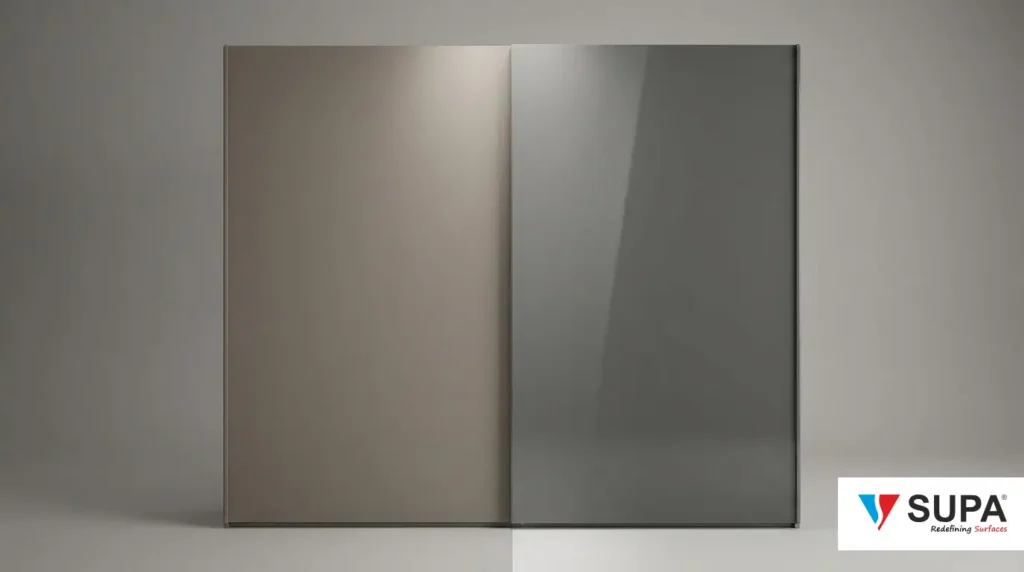
Laminate is a factory-pressed decorative sheet bonded onto a board, while PU, or polyurethane, paint is a sprayed-on liquid finish applied and cured directly on site or in a paint booth. Laminate gives a more consistent, scratch resistant surface out of the box at a lower cost, while PU paint gives a smoother, more custom colour-matched finish at a higher price and with more on-site variability. The right choice depends on whether the project prioritises consistency and budget or a fully custom colour and seamless look.
How Laminate and PU Paint Are Actually Applied
Laminate arrives as a pre-finished sheet that gets bonded onto a board and edge banded, a process that is largely factory controlled and repeatable. PU paint is sprayed onto a prepared MDF surface in multiple coats with sanding between layers, then cured, a process that depends heavily on the applicator’s skill and the spray booth conditions on the day.
Where Laminate Wins
Laminate wins on consistency across a large order, since every sheet from the same batch looks identical, and on turnaround, since there is no multi-day spray and cure cycle involved. It also resists scratching and chipping better in daily use, since the surface is a dense pressed resin rather than a paint film.
Where PU Paint Wins
PU paint wins on colour flexibility, since it can be custom mixed to match almost any shade, and on achieving a fully seamless look across curved or shaped furniture profiles that a flat laminate sheet cannot wrap around as cleanly. It also gives a softer, more premium touch feel that some clients specifically want for statement pieces.
Laminate vs PU Paint at a Glance
The table below sets out the main tradeoffs between the two finishes.
| Factor | Laminate | PU Paint |
|---|---|---|
| Application method | Factory pressed sheet, bonded on site | Sprayed and cured on site |
| Finish consistency | High, batch controlled | Variable, depends on applicator |
| Cost | Lower | Higher |
| Turnaround | Fast | Slow, multi-day cure |
| Colour flexibility | Fixed catalogue shades | Fully custom mixed |
| Best for curved surfaces | Limited | Strong |
Cost and Timeline Differences
Laminate typically costs less per square foot and installs faster since it skips the spray and cure cycle entirely. PU paint costs more due to labour intensive multi-coat application and takes longer to finish, since each coat needs proper curing time before the next is applied or the surface is handled.
What Supalam Recommends for Mixed-Finish Projects
Supalam recommends laminate for the bulk of a project, wardrobes, kitchen carcasses, and general cabinetry, where consistency and budget matter most, reserving PU paint for a small number of statement pieces where a custom colour is essential. Supalam’s 1mm Unitop and Acryglem ranges cover most of the finish variety a PU paint job would otherwise be commissioned for, at a fraction of the cost and lead time. Supalam stocks both ranges through its dealer network, so a mixed-finish specification can usually be sourced from a single supplier rather than coordinating between a laminate vendor and a separate paint contractor. Supalam suggests requesting a laminate sample against the target PU shade early in the design process, since a close laminate match often removes the need for a separate paint commission altogether.
Frequently Asked Questions
Is PU paint more durable than laminate?
Durability depends on application quality. A well applied PU finish can be durable, but laminate generally resists everyday scratching and chipping more consistently across an entire order.
Why does PU paint cost more than laminate?
PU paint requires multiple sprayed coats, sanding between layers, and dedicated curing time, all of which add labour and turnaround cost compared to bonding a pre-finished laminate sheet.
Can laminate match any custom colour?
Laminate is limited to the shades available in a manufacturer’s catalogue, while PU paint can be custom mixed to match almost any target colour.
How long does a PU paint finish take to complete?
A PU paint job typically takes several days longer than a laminate installation due to multiple coats and curing time between each layer.
Can laminate and PU paint be used in the same room?
Yes. Many projects use laminate for the bulk of the furniture and PU paint selectively for one or two statement pieces where a custom colour is the priority.
Get Started
Compare laminate finishes against your target shade in the e-catalogue, or browse the laminates product page for the full colour range. Contact Supalam for a sample before deciding between laminate and a custom PU paint commission.