
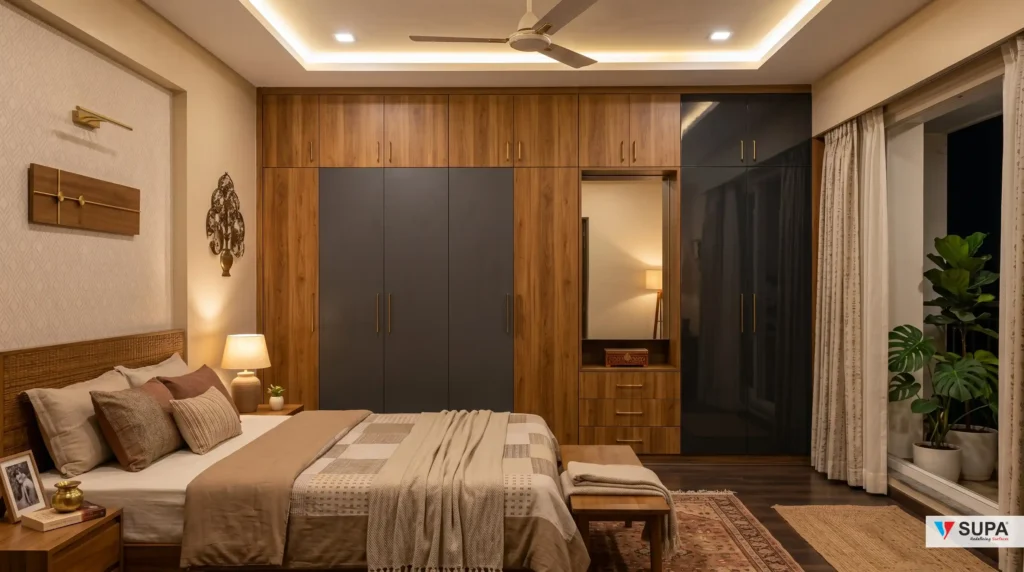
A wardrobe is the most-used piece of furniture in any bedroom. The laminate on it gets touched, opened, and closed hundreds of times a year for the next decade. Choosing the right surface is not about trends, it is about finding a finish that still looks good three years from now when the novelty has worn off.
Supalam supplies wardrobe laminates to furniture manufacturers and interior designers across Delhi NCR, Haryana, and across India. Here is what actually gets specified and why.
Why Laminate Is the Go-To Surface for Wardrobes in India
Laminate dominates the Indian wardrobe market because it balances cost, durability, and design range better than any other surface material. Veneer wardrobes are available for premium projects but require maintenance. PU paint wardrobes chip at edges. Acrylic wardrobes scratch and are expensive to repair.
A 1mm high-pressure laminate from Supalam’s Unitop or Supa Lam range, properly applied to a good MDF or particle board carcass with sealed edge band, will maintain its appearance for ten to fifteen years under normal bedroom use. That is the baseline standard that most buyers do not realise is achievable at reasonable cost.
Finish Guide: What to Use Where in a Wardrobe
| Wardrobe Area | Recommended Finish | Why |
|---|---|---|
| Shutter doors (external) | Matte or woodgrain 1mm | Low fingerprints, durable, ages well |
| Shutter doors (feature) | High gloss 1mm+ (1–2 panels only) | Statement accent without full gloss issues |
| Internal shelves | 0.8mm matte or solid | Cost-efficient, not visible in daily use |
| Back panel (inside wardrobe) | 0.8mm solid (any colour) | Invisible, economy specification |
| Drawer fronts | 1mm matte or woodgrain matching doors | Consistency, frequent contact needs 1mm |
| Carcass sides (visible) | 1mm matching door design | Visual continuity from side angles |
The Colours That Are Working in Indian Bedrooms Right Now
Warm woodgrain tones are the dominant wardrobe specification in 2025–2026. Oak and walnut patterns in medium tones work with almost any wall colour and bedding choice, which is why they are the safest specification for wardrobes that need to look good for years. Supalam’s Unitop range carries a broad woodgrain selection with deep-embossed textures that read as genuine wood from a normal viewing distance.
For contemporary bedrooms with a specific design direction, two-tone wardrobes are increasingly requested. The typical combination is a neutral matte upper frame with a warmer woodgrain or contrasting solid colour on the shutter doors. Dark tones, charcoal and deep grey, are popular for master bedroom wardrobes in apartments where the bedroom has controlled lighting.
White and off-white remain consistent choices for smaller bedrooms because they read as clean, reflect light, and make the space feel less enclosed. Supalam’s solid white in the Supa Lam range is one of its most consistently ordered designs for this reason.
Sliding vs Hinged Wardrobes: Does It Change the Laminate Specification?
For sliding door wardrobes, the shutter panels see significant edge wear as they travel in the track system. The edges must be finished with at least 1mm matching edge band, not 0.5mm, to handle the repetitive movement without chipping. Sliding door panels also benefit from slightly thicker substrates, typically 18mm MDF, which helps the panel stay flat over time.
For hinged door wardrobes, the specification priority is hinge area reinforcement and ensuring the panel does not warp. Warping is almost always a substrate issue, not a laminate issue. Good 18mm MDF with proper laminate application on both faces (not just the visible side) keeps panels flat.
Supalam’s Supa Edge Band is colour-matched to every laminate in the range using the same decor code system. For sliding wardrobes where edge wear is the first thing to show, using matched edge band from the same manufacturer eliminates the colour drift that happens when edge band is sourced separately.
Common Mistakes When Choosing Wardrobe Laminates
- Choosing gloss for the entire wardrobe: it shows every fingerprint and every scratch within months. Use gloss selectively as one or two accent panels.
- Using 0.8mm on shutter doors to save cost: the saving is typically Rs 100–150 per sheet. Over a 10-year lifespan, the reduced edge durability is not worth it.
- Not laminating the back panel: an unfinished back panel absorbs moisture and smells. Even a thin 0.8mm solid laminate on the back panel prevents this.
- Buying laminate and edge band separately from different suppliers: colour matching is unreliable. Supalam supplies both from the same production system.
Frequently Asked Questions
1. Which is the best laminate colour for a small bedroom wardrobe?
Light woodgrain or off-white solid laminates are the best choice for a small bedroom. They reflect light, reduce the visual weight of the wardrobe, and do not make the room feel smaller. Dark tones work in large master bedrooms with good lighting, but in a compact room they close the space down. Supalam’s oak woodgrain in the Unitop range is one of the most specified designs for small to mid-sized Indian bedrooms.
2. Can I use kitchen laminates on a wardrobe?
Yes, though it is not necessary. Kitchen laminates are specified with heat and moisture resistance which a wardrobe does not need. Standard Supalam 1mm Unitop or Supa Lam laminates are the correct specification for wardrobes and are more economical than kitchen-grade variants. Save the kitchen laminate for the kitchen.
3. How many sheets does a standard 6-door wardrobe need?
A standard 6-door sliding wardrobe approximately 8 feet wide and 8 feet tall requires 12 to 15 sheets of 8×4 laminate depending on whether internal shelves and the back panel are also laminated. Your furniture manufacturer or carpenter can provide an exact cutlist. Supalam can supply both the laminate and matching edge band in a single order.
4. What edge band thickness should I use for wardrobe shutters?
Use 1mm to 2mm PVC edge band for wardrobe shutter doors. 0.5mm edge band is adequate for shelving but not for frequently handled doors. Supalam supplies Supa Edge Band in matching designs to all its laminate ranges, available in the standard thicknesses for furniture applications.
5. Is it better to use laminate or membrane press (PVC) for wardrobes?
Laminate is more durable than membrane-pressed PVC for wardrobes in Indian conditions. Membrane press (also called acrylic PVC or thermofoil) is prone to peeling at edges in humid conditions and near heat sources. Laminate, applied with proper adhesive and sealed with edge band, holds up significantly better over a 10 to 15 year period. For quality furniture that lasts, laminate is the correct specification.
Explore Supalam’s full wardrobe laminate range at supalam.com/products/laminates/ including Unitop, Supa Lam, and Supa Edge Band. Download the catalogue at supalam.com/e-catalogue/ or call +91 989 905 4064.