
The number of laminate options available today is genuinely overwhelming if you approach the decision without a framework. Walk into a dealer showroom without a plan and you will spend considerable time looking at samples without getting closer to a decision that actually fits your project.
This guide gives you that framework. Room by room, factor by factor. By the end you will know what to look for and why, which saves both time and expensive specification mistakes.
Four Variables That Should Drive Every Laminate Decision
Before looking at colours or surface aesthetics, four functional variables should anchor the choice for each room in a home.
- Moisture exposure: How much water, steam, or ambient humidity will this surface regularly encounter?
- Physical wear: How often will the surface be touched, impacted, or loaded with weight?
- Lighting conditions: Is this a naturally lit or artificial light environment? Is the room bright or relatively dim?
- Design intent: Warm or cool? Bold or restrained? Contemporary, traditional, or somewhere in between?
Once these four are answered for a specific room, the laminate decision narrows to a manageable set of real options rather than the entire catalogue.
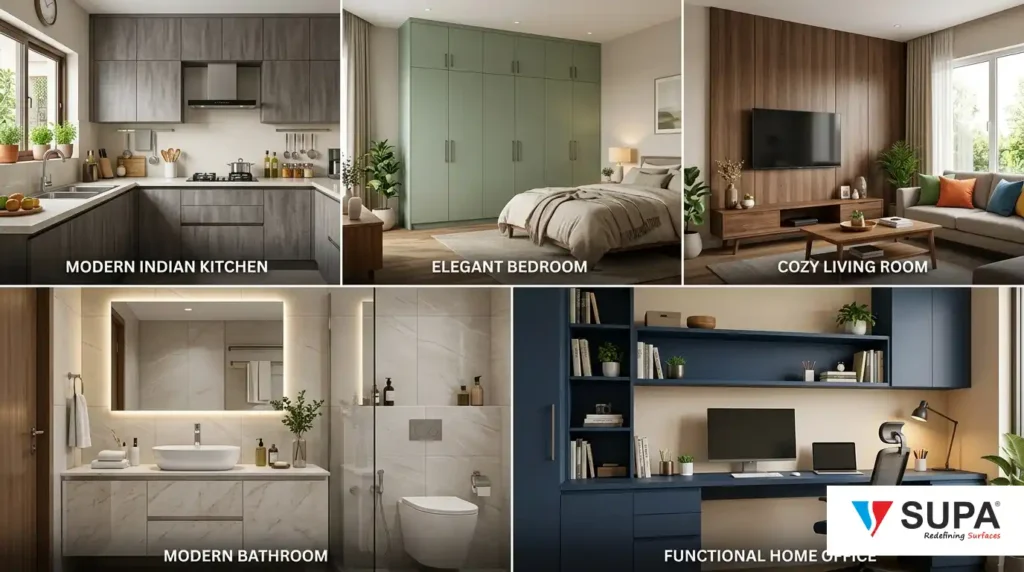
Kitchen
The kitchen is the hardest-working surface environment in any home. Your laminates need to handle heat proximity from cooking appliances, cooking grease on shutter fronts, regular wiping and washing, and sustained physical contact from multiple users. The minimum specification here is HPL grade, which is denser and more resistant than standard decorative laminate sheets.
Matt and textured finishes are the practical choice for kitchen shutters because they conceal daily marks and grease traces better than gloss. If the design calls for gloss, use it on upper cabinets away from the primary cooking zone and pair it with easy-clean hardware. Supalam’s Kitchen Laminates range addresses heat, moisture, and stain resistance as a combined specification rather than requiring compromise between them.
Bedroom and Wardrobe
The bedroom is about comfort and personal expression. The primary laminate application is the wardrobe – typically the largest furniture surface in the room – and the finish choice here sets the room’s overall tone. Matt laminates dominate bedroom specifications because they create warmth without the maintenance demands of gloss. Super matt is growing rapidly as the premium choice for master bedrooms. Wood finish laminates remain consistently popular for the organic warmth they bring to the space.
Interior wardrobe surfaces are a separate specification decision. Light-toned, easy-clean matt laminates work well for shelves and internal panels regardless of what finish is used on the exterior shutters.
Living Room
Living room laminate applications cover TV units, display shelves, console tables, and increasingly feature wall panels. This is the space where design expression matters most and where the laminate choice can make the biggest visual impact relative to everything else in the room.
A layered approach works well here. A wood-grain laminate anchoring the TV unit, with matt or subtly textured laminates on surrounding cabinetry, creates depth and material hierarchy without visual confusion. This is the type of combination that Supalam’s range is curated to support with complementary palettes across finish categories.
Bathroom
Moisture resistance is the non-negotiable criterion for bathroom laminates. Not all laminate sheets are appropriate for wet area use. You need an HPL grade with explicit moisture resistance certification, and the installation must seal all cut edges properly. Supalam’s moisture-resistant grades handle bathroom vanity applications correctly.
Light colours make bathrooms read as cleaner and larger. White, off-white, light grey, and pale stone tones are the reliable palette for bathroom applications. Matt finishes work better than gloss here because they resist water mark visibility, which is a daily maintenance issue on gloss surfaces in bathroom settings.
Study and Home Office
Visual comfort over extended work sessions is the primary consideration for home office spaces. High-gloss surfaces reflect screen light and contribute to eye fatigue during long working hours. Matt finishes in neutral tones – warm greys, whites, and natural wood grain laminates – are the appropriate specification for a functional workspace.
Surface hardness matters here too because desks take daily impact from laptops, books, and objects. Specifying a scratch-resistant HPL grade for the primary desk work surface is worthwhile since surface damage is both visually distracting and difficult to repair cleanly.
Children’s Room
Practical over aesthetic, though the two are not mutually exclusive. Children’s room furniture takes consistent impact, moisture from spills, and creative decoration attempts with everything from pencils to stickers. Scratch-resistant matt laminates in cheerful but not overwhelming colours are the reliable specification.
Avoid very light gloss surfaces because every mark will be visible immediately. Avoid very dark surfaces in children’s rooms because they can feel heavy in a space that benefits from lightness. Mid-tone matt in warm or playful colours is the comfortable and durable middle ground.
Quick Reference for All Rooms
| Room | Priority Specification | Best Finish | Colour Direction |
|---|---|---|---|
| Kitchen | Moisture and scratch resistant HPL | Matt or textured | Neutral, warm tones |
| Bedroom | Standard HPL | Matt, super matt, or wood finish | Warm neutrals and jewel tones |
| Living room | Standard HPL | Wood grain combined with matt | Warm and naturalistic palette |
| Bathroom | Moisture-resistant HPL grade | Matt | Light tones, stone, clean white |
| Home office | Scratch-resistant HPL | Matt | Neutral, low-contrast tones |
| Children’s room | Scratch-resistant HPL | Matt | Playful mid-tones, not too dark |
Connecting Rooms Without Losing Individuality
One of the more common mistakes in full-home interior projects is treating each room in complete isolation from the ones around it. When adjacent rooms use completely unrelated palettes and finishes, the overall home feels fragmented rather than designed.
A practical approach is to define a base palette of one or two complementary tones that runs through shared areas like corridors and the living space, then allow individual rooms to build their character within that broader family. Supalam’s range is curated with cross-room coordination in mind, so finding laminates that feel related across different finish types is achievable without forcing visual uniformity.
Download the Supalam e-Catalogue for the Full Range Across All Finishes and Grades | supalam.com
Frequently Asked Questions
How do I choose the right laminates for a modular kitchen?
Prioritise moisture resistance, scratch resistance, and heat tolerance. High pressure laminates in 1 mm thickness are the standard specification for kitchen shutters. Avoid very light gloss finishes near the cooking zone where grease splatter is frequent. Matt or textured finishes in mid-tones are the most practical and durable choice for kitchen use.
What laminate finish works best in a living room?
Living rooms benefit from a layered approach using warm wood finishes, textured surfaces, or a combination of matt and gloss to define different zones. For example, a wood-grain TV panel with matt cabinetry creates depth and warmth without visual competition between elements.
Can laminates be used for bathroom vanity fronts?
Yes, with the correct grade specification. Choose an HPL laminate explicitly rated for moisture resistance in wet area applications. Seal all cut edges during installation with waterproof edge banding or adhesive to prevent moisture ingress at joints, which is where most failures occur.
Is it better to use the same laminate throughout a home?
Technically possible but rarely the best outcome. Different rooms have different functional requirements and aesthetic tones. A consistent design language using a limited palette of two or three complementary laminates across connected spaces usually produces better results than a single surface used uniformly throughout.
How many different laminate finishes should be used in one room?
Most experienced designers work with a maximum of three to four laminate variants within a single space. This gives enough variety to create depth and visual interest while maintaining coherence. More than four distinct finishes in one room typically creates a fragmented look that reduces rather than enhances the design quality.