
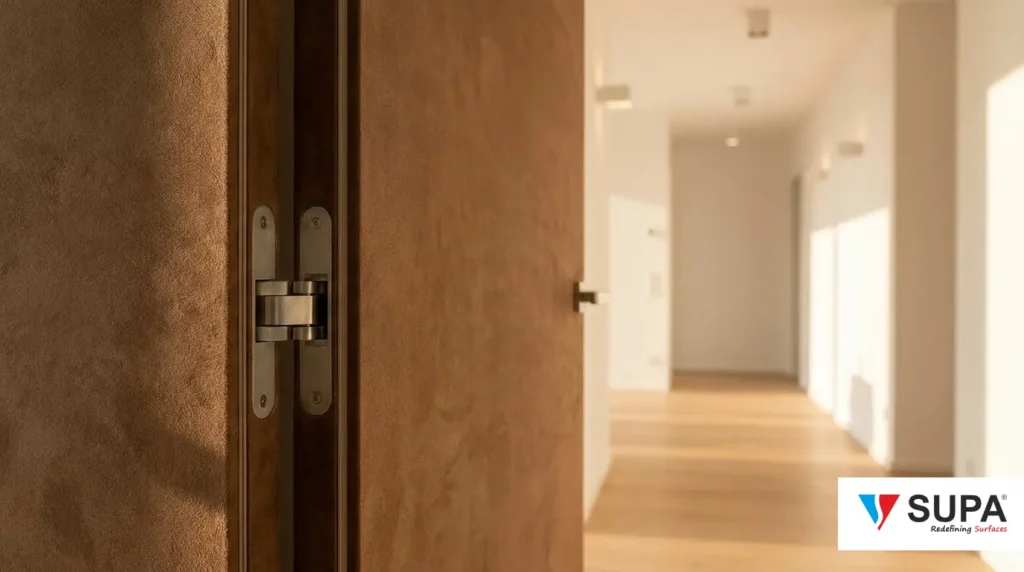
Door skin laminate is a laminate sheet specifically sized and specified for flush door faces, built to handle the larger unsupported panel area and repeated opening and closing stress that a door experiences but a fixed cabinet shutter does not. It differs from standard cabinet laminate mainly in panel size options and, in some ranges, a bonding recommendation designed to prevent warping over a taller span. Choosing the right door skin means matching the sheet to the door core material and the room’s humidity conditions, not just picking a finish from the catalogue.
What Makes Door Skin Laminate Different
A cabinet shutter is small and supported on multiple edges by the carcass frame, while a door panel is a large, mostly unsupported span that flexes slightly with every open and close cycle over years of use. Door skin laminate needs to handle this repeated flexing without the surface delaminating at the edges, which is why panel size, sheet thickness, and bonding method all matter more for doors than for standard cabinetry.
Core Compatibility for Door Applications
A door core, whether solid block board, flush door core, or engineered core, needs to be dimensionally stable enough to avoid warping under humidity changes, since any core movement transfers directly to the laminate face and can cause it to crack or lift at the edges over time. Matching a quality door core to a quality door skin laminate matters more than either choice made in isolation.
Door Skin Laminate: Key Specification Checklist
The table below sets out what to confirm before ordering door skin laminate for a project.
| Check | What to Confirm | Why It Matters |
|---|---|---|
| Panel size | Sheet covers standard door dimensions without piecing | Avoids visible seams on a large flush face |
| Core type | Matched to a dimensionally stable door core | Prevents warping under humidity change |
| Balanced lamination | Both faces laminated, not just the visible one | Stops uneven tension that causes warping |
| Edge sealing | Every cut edge sealed with matching edge band | Prevents moisture ingress at door edges |
Common Installation Mistakes That Cause Warping
The most common cause of door warping is bonding laminate to only one face of the door without a balancing layer on the opposite face, which creates uneven tension across the panel as humidity changes. Skipping edge sealing on a door face is another frequent mistake, since exposed edges absorb moisture unevenly and pull the panel out of shape over a season or two.
Choosing a Finish for High Traffic Doors
Entry doors and frequently used interior doors benefit from a matte or suede finish for the same reason kitchen countertops do, minor surface marks from handles and daily contact show up less than they would on a high gloss face. Bedroom and low traffic interior doors have more flexibility to use a gloss or decorative finish since the wear profile is lighter.
Supalam’s Door Skin Range
Supalam manufactures its door skin range with panel sizing built specifically for standard flush door dimensions, rather than expecting a fabricator to cut down a standard cabinet sheet and risk an inconsistent edge. Supalam recommends balanced lamination on both faces of any door panel to prevent the warping issue that accounts for most early door failures. Supalam lists door skin panel sizes and finish options separately from the standard laminate catalogue in the e-catalogue, making it easier to specify the correct sheet for a door job without confusing it with cabinet grade stock.
Frequently Asked Questions
Can standard cabinet laminate be used on a door instead of door skin?
It can, but standard cabinet-sized sheets may not cover a full door face without a seam, and the bonding recommendations for a large flexing panel differ from those for a small supported shutter.
Why do laminate doors warp over time?
Warping is most often caused by laminating only one face of the door or skipping edge sealing, both of which allow uneven moisture absorption and tension across the panel.
Does the door core matter as much as the laminate finish?
Yes. A dimensionally unstable core will transfer movement to the laminate face regardless of how good the laminate itself is, so core selection matters just as much.
What finish works best for a frequently used interior door?
A matte or suede finish is recommended for high-traffic doors since it hides minor handle marks and daily contact better than a high gloss surface.
Should both faces of a door be laminated?
Yes, in most cases. Balanced lamination on both faces prevents the uneven tension that leads to warping over time.
Get Started
Browse door skin sizes and finishes in the e-catalogue, or check the laminates product page for compatible core recommendations. Contact Supalam for guidance on matching a door core to the right door skin sheet.