
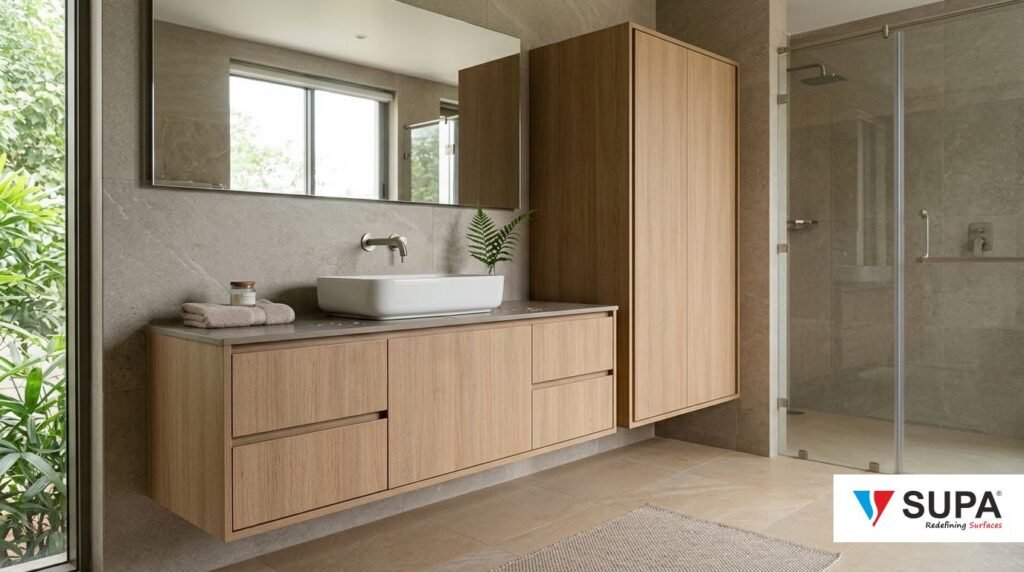
Bathroom furniture fails for one reason more often than any other: moisture getting into the substrate underneath the laminate, not the laminate surface itself failing.
That distinction matters because picking the right laminate finish is only half the job. The plywood or board grade underneath has to be moisture-resistant too, or water will find its way in through the edges and joints regardless of how good the surface laminate is.
Getting both halves right, the laminate and the substrate, is what actually keeps a bathroom vanity or cabinet from swelling and delaminating within a year or two.
It’s a detail that’s easy to overlook when a bathroom cabinet is being chosen mainly on colour and finish, but it’s the single factor most likely to determine whether that cabinet still looks good in five years or needs replacing within two.
The Substrate Underneath Matters More Than the Laminate Finish
Standard interior-grade plywood or MDF will absorb moisture over time even with a laminate face bonded on top, because water gets in through cut edges, screw holes and joints rather than through the laminate surface itself. BWP (Boiling Water Proof) or BWR (Boiler Water Resistant) grade boards are built to resist that moisture ingress and are the correct substrate choice for any bathroom cabinet, vanity unit or wet-area furniture.
Skipping this step and using a standard board with a nice laminate finish on top is the single most common cause of bathroom furniture failure. The surface can look perfect while the core is already swelling from the inside.
This is also why a bathroom cabinet that looked fine at handover can start showing problems six months to a year later rather than immediately. Moisture ingress through an unprotected core is a gradual process, so the swelling, soft spots or discolouration typically appear only after repeated exposure has had time to accumulate, well after the original installer has moved on to other work.
HPL Outperforms LPL in Bathroom Applications
High Pressure Laminate is the better choice for bathroom surfaces because its denser, multi-layer construction resists moisture and humidity better than the thinner, lower-pressure construction of LPL. This matters even more in a bathroom than in a kitchen, since humidity levels stay elevated for longer after every shower rather than the intermittent splashing a kitchen counter sees.
Matte and suede finishes are generally preferred over high gloss in bathrooms too, since gloss surfaces show water spots and soap residue far more visibly under bathroom lighting.
Edge Sealing Is the Detail Most Installations Get Wrong
Even with the right laminate and the right substrate, an unsealed or poorly edge-banded cut edge gives water a direct path into the board core. Every exposed edge on a bathroom cabinet, including around cutouts for plumbing, drawer fronts and door edges, needs continuous, properly bonded edge banding with no gaps.
This is the detail that separates bathroom furniture that lasts a decade from furniture that needs replacing within two or three years, and it costs almost nothing extra to get right at the time of installation.
Choosing Laminate Colours and Finishes That Work Long-Term in Humid Rooms
Colour choice in a bathroom carries a practical dimension that other rooms don’t need to consider as carefully. Very light, uniform colours tend to show water spots, hard water marks and soap scum more visibly than mid-tone or textured finishes, particularly around the sink and shower zones where splashing is constant.
Textured and stone-effect finishes have become popular in bathrooms specifically because the surface pattern hides minor water marks and light scratching far better than a flat solid colour does, while still giving a clean, modern look. Ventilation also plays a bigger role than most people expect: a bathroom with poor airflow will shorten the effective lifespan of even a correctly specified BWP board and HPL combination, so an exhaust fan or window that actually gets used daily is as much a part of protecting the furniture as the material choice itself.
Maintenance Tips to Extend the Life of Bathroom Laminate Furniture
Wiping down cabinet surfaces after a shower, rather than letting water sit and evaporate on its own, meaningfully reduces the long-term moisture exposure the laminate and edge banding are subjected to. Standing water left pooled at the base of a vanity unit for extended periods is one of the fastest ways to compromise even a well-sealed edge, so a quick daily wipe is worth far more than an occasional deep clean.
It’s also worth inspecting edge banding every six months or so for any sign of lifting, particularly around high-splash zones like the sink cutout, and addressing it immediately with a carpenter rather than waiting, since a small edge gap left unaddressed for months is what eventually turns into full delamination and a swollen core.
Choosing a Supplier You Can Trust for Wet-Area Boards
Because the failure point for bathroom furniture is usually invisible at the time of purchase, buried inside the substrate rather than visible on the laminate surface, the supplier’s track record on grade consistency matters more here than almost any other furniture category. Ask specifically for BWP or BWR grade certification on the boards being quoted, rather than accepting a general assurance that a board is suitable for bathrooms.
A reliable supplier should also be able to specify exactly which HPL or laminate range is being paired with the waterproof substrate, since a good core paired with a poorly matched or overly thin laminate face can still underperform in a humid room. Supalam’s particle board and laminate ranges are documented to grade in the e-catalogue specifically so dealers and homeowners can verify substrate and surface specifications together before committing to a bathroom furniture order, rather than having to take those claims on trust.
It’s also worth asking a supplier directly how their boards perform under sustained humidity rather than a single splash test, since the two conditions stress a board very differently. A board that shrugs off an occasional water spill can still swell over months of daily bathroom humidity if the internal resin bonding wasn’t formulated for continuous moisture exposure, which is exactly the kind of detail a specification sheet or grade certificate will confirm and a verbal assurance alone will not.
At a Glance: Comparison Table
| Component | Recommended for Bathrooms | Avoid |
|---|---|---|
| Substrate | BWP / BWR grade plywood or MDF | Standard interior-grade board |
| Laminate type | HPL (High Pressure Laminate) | Thin LPL in high-humidity zones |
| Finish | Matte or suede | High gloss (shows water spots) |
| Edge treatment | Continuous, gap-free edge banding | Unsealed or partially banded edges |
| Highest-risk areas | Under-sink cabinets, vanity base | N/A |
Frequently Asked Questions
Is laminate alone waterproof for a bathroom?
No. The laminate surface resists surface moisture, but true water resistance for a bathroom cabinet depends on pairing it with a BWP or BWR grade substrate, since water enters through edges and joints, not the laminate face.
Should I use HPL or LPL in a bathroom?
HPL is the better choice for bathrooms because its denser construction handles sustained humidity better than the thinner, lower-pressure build of LPL.
Why do bathroom cabinets swell even with laminate on them?
This almost always traces back to either a standard, non-waterproof substrate underneath the laminate or gaps in the edge banding that let moisture into the board core over time.
Is matte or gloss finish better for a bathroom?
Matte or suede finishes are generally preferred in bathrooms since gloss surfaces show water spots and soap residue much more visibly under typical bathroom lighting.
What’s the single most important detail for bathroom furniture durability?
Continuous, properly bonded edge banding around every cut edge. It’s the low-cost detail that most directly determines whether bathroom furniture lasts many years or fails within two or three.
Check Supalam’s BWP-grade board and laminate combinations suited to bathroom and wet-area furniture in the product catalogue, or browse the full laminate range in the e-catalogue.