
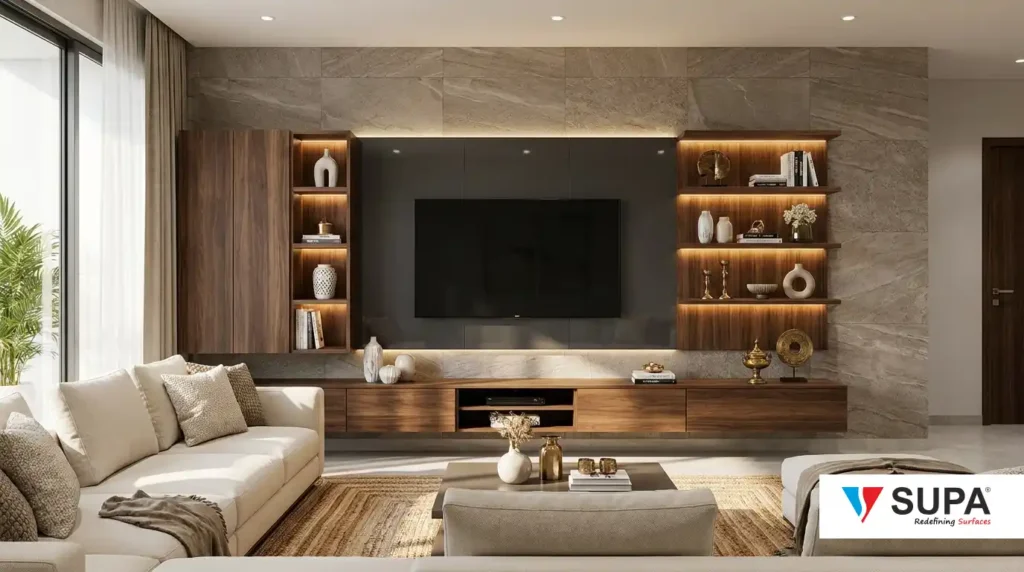
The living room does different work than the kitchen or bedroom. The furniture here is the first thing a visitor sees, it is where you spend most of your waking hours at home, and the pieces TV unit, crockery cabinet, display shelving are statement items rather than purely functional ones. The laminate specification for living room furniture is therefore driven more by finish quality and design coherence than by wear resistance alone.
That said, TV units accumulate fingerprints, dust, and the occasional scratch from cable management. Crockery units take the weight of ceramic and glassware. This is not a zero-maintenance environment. The right specification balances visual impact with realistic upkeep.
How Living Room Furniture Specification Differs From Kitchen or Wardrobe
Kitchen laminates are specified first for durability. Wardrobe laminates are specified for durability and design range. Living room furniture laminates are specified primarily for design impact, with durability as a secondary but still important consideration.
This means the laminate choice for a TV unit can justify a premium finish deep woodgrain texture, stone effect, or high-gloss accent panel that would be impractical or over-specified in a bedroom wardrobe. The living room is where the most dramatic finishes earn their keep.
2026 Living Room Finish Trends in Indian Interiors
Several clear directions are dominating new residential interior specifications in India right now:
- Fluted and ribbed panel surfaces on TV unit faces and cladding walls using 3D routed MDF with a uniform laminate overlay or linear strip laminates to create depth and shadow lines
- Two-tone furniture a warm woodgrain lower unit with a contrasting matte upper or display cabinet, often in charcoal, off-white, or deep olive
- Stone-effect laminates on TV unit backs and feature wall panels marble and slate textures in large-format impression
- Dark and moody living rooms with deep walnut or ebony laminates on TV units against neutral or white walls
- Japandi-influenced combinations light ash and linen-texture laminates with minimal hardware and clean lines
Laminate Finish Selector for TV Units and Living Room Furniture
| Living Room Piece | Recommended Finish Type | Finish Examples | Surface to Avoid |
|---|---|---|---|
| TV unit main body | Matte woodgrain 1mm or deep-texture woodgrain | Oak, walnut, ash, teak grain | Full-gloss on large panels shows every dust particle |
| TV unit feature back panel | High-gloss solid OR stone-effect | Gloss white, gloss charcoal, marble texture | Heavy woodgrain competes with front design |
| Crockery cabinet exterior | Matte solid or fine texture | Warm whites, greige, soft sage | Gloss fingerprints from daily opening are constant |
| Display shelving visible shelves | Matte woodgrain or solid | Light oak, off-white, linen texture | 0.8mm on horizontal shelves use 1mm minimum |
| Floating wall panels / cladding | Stone effect, 3D linear, or deep texture | Slate, limestone, micro-concrete look | Woodgrain on large walls can feel heavy |
| Coffee table surface | Matte or semi-gloss solid / stone | Greige, white marble, concrete grey | High-gloss scratches visible immediately |
The Case for Mixing Finishes in the Living Room
Single-finish living rooms feel flat. The most successful living room furniture specifications in 2026 use deliberate contrast typically between a textured or woodgrain primary surface and a cleaner matte or gloss secondary surface. This is not an arbitrary aesthetic preference; it is how good material specification creates visual depth in a room.
A practical example: a TV unit with a medium walnut woodgrain main body and a single high-gloss charcoal back panel behind the television creates a focal point without requiring custom joinery. The woodgrain reads as warm and natural. The gloss panel creates depth behind the screen. Both are standard laminate products the design intelligence is in the combination, not in the individual material choice.
The rule most experienced designers apply is the 70-20-10 principle: 70 percent of the furniture surface in the primary finish, 20 percent in the secondary finish, and 10 percent as an accent (hardware, edge, or a single feature panel). Applied to laminate specification, this translates to one dominant woodgrain or matte finish, one complementary contrast finish, and hardware or edge banding as the accent detail.
Digital Print Laminates: When to Consider Custom Surfaces
For living rooms where a catalogue finish is insufficient hospitality lobbies, luxury residences, or commercial reception areas digital print laminates offer a fundamentally different specification option. A digital print laminate can carry any graphic, pattern, or texture at full-panel scale. This means a feature wall behind a TV unit can carry a custom woodgrain that is not available in any standard catalogue, a site-specific pattern, or even a photographic image rendered in laminate.
This technology has matured significantly in the Indian market. Products like the Supa Digipedia range from Supalam bring custom digital print to HPL format, allowing architects and designers to specify unique surfaces without the fabrication complexity of custom paint, wallcovering, or stone. For a feature wall in a premium apartment or a hotel lobby unit, the cost difference compared to catalogue laminates is recoverable in reduced site complexity and shorter fabrication lead times.
Texture and Touch: What Gets Overlooked in Online Specification
Laminate specification in India increasingly happens from catalogue PDFs and on-screen renders rather than physical samples. The result is that surface texture one of the most important distinguishing characteristics of premium laminates is frequently underweighted in the specification decision.
A deep-embossed woodgrain laminate and a flat-print woodgrain laminate look similar in a photograph. In the room, under natural light, they are completely different materials. The embossed surface creates shadow lines across the grain pattern that give the surface visual depth and a tactile quality that cannot be photographed. The flat-print surface looks digital and flat.
For any visible surface in a living room TV unit faces, cabinet fronts, feature wall panels always request a physical sample before confirming the specification. What looks right on screen may not look right at the size and lighting of the actual application. This is particularly important for stone-effect and metallic-finish laminates where the real-world appearance at large scale can differ substantially from a small catalogue photograph.
Frequently Asked Questions
Q1. What is the best laminate finish for a TV unit in 2026?
For most Indian living rooms, a deep-embossed woodgrain in medium walnut, oak, or teak tones on the main body with a single high-gloss or stone-effect back panel is the most versatile specification. This combination works across different wall colours and furniture styles without dating quickly. Avoid specifying the entire TV unit in high-gloss unless the room has very controlled lighting gloss surfaces in rooms with large windows or multiple light sources show dust, fingerprints, and reflections that can be distracting.
Q2. Can laminates be used for wall cladding in a living room?
Yes. Wall panel cladding is one of the fastest-growing applications for decorative laminates in urban Indian interiors. For feature walls behind TV units or as room dividers, 1mm HPL bonded to MDF backing panels provides a high-quality, low-maintenance wall surface. The bonded panel approach allows for panel-by-panel installation that can be dismantled without wall damage, which is particularly relevant in rented apartments. Ensure the MDF backing is at least 6mm and that panels are mounted with adequate fixings to the wall.
Q3. How do I prevent scratches on living room laminate furniture?
For a TV unit or crockery cabinet, use felt pads under any objects that are regularly placed or moved on the surface. Avoid sliding decorative items, remote controls, or electronic devices across matte laminate surfaces as hardware (screws, metal edges) will scratch even hard HPL over time. For cleaning, a dry microfibre cloth removes dust without abrasion. A barely-damp cloth with a neutral pH cleaner handles marks. Never use abrasive cleaners, steel wool, or solvent-based products on any decorative laminate.
Q4. Is digital print laminate durable enough for furniture use?
Digital print laminates manufactured as HPL (high-pressure laminate) have the same structural durability as any other HPL in the same thickness range. The printing is below the protective overlay, which means the surface scratch resistance, moisture resistance, and cleanability are the same as a standard laminate. The overlay protects the print from UV fading and abrasion. For indoor furniture and wall panel applications in Indian conditions, digital print HPL from a quality manufacturer performs comparably to catalogue-design HPL.
Q5. What thickness of laminate is right for floating shelves in a TV unit?
Floating shelves that carry items books, decorative objects, equipment should use 1mm HPL on the visible face and top surface. If the shelf is a structural shelf (the substrate is MDF or plywood), the laminate specification is the same as for any furniture panel. Do not use 0.8mm on a horizontal shelf that will carry load, as the surface shows wear from item placement and movement faster than 1mm on the same substrate. The underside and back can use 0.8mm or prelam board if they are not visible.
Q6. How do I match the laminate on a TV unit with my existing flooring?
Matching living room furniture to flooring is a matter of tone coordination rather than identical material. The safest approach is: if your flooring is a warm medium woodgrain (teak or bamboo), use a lighter or cooler woodgrain on the furniture for example, oak or ash to create contrast without conflict. If your flooring is a cool grey or dark material, warm woodgrains like walnut on furniture work well. Avoid using the exact same grain pattern on both floor and furniture as this creates a confusing visual field without clear hierarchy.