
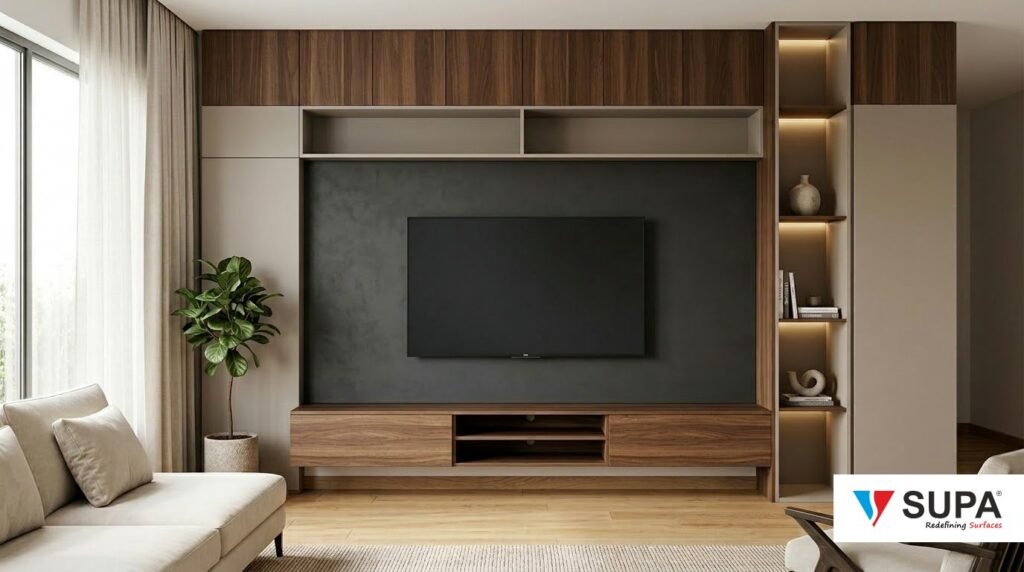
A TV unit gets more visual attention than almost any other piece of furniture in the living room, so the laminate finish you pick has to do double duty. It needs to look good under direct light and hold up to daily handling around remotes, set-top boxes and cables.
Unlike a wardrobe or kitchen cabinet, a TV unit is usually low-traffic in terms of physical wear but high-visibility in terms of design, which shifts the priority from pure durability toward finish quality, colour depth and how the panel looks under the TV’s ambient light.
The right laminate choice depends mainly on the room’s lighting and the rest of the living room palette, not on thickness alone.
Because the TV unit is usually the first thing visitors notice when they walk into a living room, getting the finish and layout right has an outsized impact on how the whole space reads, far more than its relatively modest share of the total furniture budget would suggest.
Matte and Suede Finishes Work Best Behind a Wall-Mounted TV
A glossy panel directly behind or below a screen tends to throw reflections back at the viewer, especially in rooms with a window or downlights facing the unit. Matte and suede finishes eliminate that glare problem entirely while still giving a clean, premium look.
Suede finishes have the added advantage of hiding fingerprints and light scuffs from handling remotes and cables, which makes them a practical choice for the lower shelves of a TV unit where hands are in contact most often.
Rooms with a large window facing the TV unit benefit the most from this choice, since even indirect daylight bouncing off a glossy panel can create a visible haze on the screen during the day, an issue that’s easy to miss when a sample is only checked under a showroom’s controlled lighting.
High Gloss Still Works, Just Not Directly Facing the Screen
High gloss laminate isn’t ruled out for a TV unit; it just needs positioning. Side panels, the units flanking the TV, or a feature wall section away from the direct sightline can carry a high gloss finish for visual impact without creating reflection problems on the main viewing surface.
This split approach, matte or suede on the panel behind the screen and gloss on the side units, is one of the most common finish strategies interior designers use for entertainment walls right now.
Wood Grain and Dark Solid Colours Are the Two Safest Choices
Wood grain laminates pair naturally with almost any living room palette and age well because the pattern hides minor scuffs better than a flat solid colour. Dark solid colours, such as charcoal, deep walnut tones or matte black, create strong contrast behind a screen and make the TV itself feel more integrated into the unit rather than sitting on top of it.
Lighter solid colours are the riskiest choice for a TV unit specifically, since they show dust, fingerprints and light scuffing far more visibly than either wood grain or darker tones.
Choosing the Right Thickness and Layout for a Floating TV Unit
Floating or wall-mounted TV units carry their full load on cantilevered brackets rather than legs, which puts more stress on the panel material than a standard floor-standing unit. A 1mm laminate on a solid core, whether plywood or a dense particle board, is the safer choice here over a thinner 0.6mm to 0.8mm sheet, since the extra rigidity helps the panel resist sagging over years of holding a soundbar, set-top box and cable clutter.
Layout matters just as much as thickness. Open shelving with a mix of closed cabinet sections tends to photograph and live better than a single unbroken laminate surface, since it breaks up the visual mass of the unit and gives the eye somewhere to land besides the screen itself. Where the design includes backlighting or a recessed niche behind the TV, a matte finish is almost always the right call, since gloss surfaces scatter that ambient light in ways that look unintentional rather than deliberate.
Common Mistakes When Designing a TV Unit Laminate Scheme
The most common mistake is choosing a high-gloss finish for the entire unit without considering the room’s window and light fixture positions, only to discover reflections on the screen every evening once the lights go on. The second is picking a laminate colour in isolation from the wall paint, which often results in a TV unit that either disappears into the wall or clashes badly with it once installed.
A third mistake worth avoiding is under-speccing the thickness on a floating unit to save cost, since sag and slight warping over time are far more noticeable and harder to fix on a wall-mounted piece than on a floor-standing one. Testing a physical sample against the actual wall colour and under the room’s real lighting, rather than judging from a catalogue swatch, remains the single best way to avoid a costly reselection after installation.
Matching Laminate to Different Living Room Styles
A contemporary, minimalist living room usually calls for a single dominant laminate finish across the TV unit, either a solid matte colour or a subtle wood grain, kept clean and free of too many contrasting elements. Ornate detailing or busy textures tend to work against the pared-back look this style is going for, so restraint in the finish choice matters more than in almost any other room style.
A traditional or warm-toned living room, by contrast, tends to suit richer wood grain laminates with visible texture, paired with brass or warm metal handles and fittings, which reinforces the classic feel rather than fighting it. Industrial and Scandinavian-inspired spaces sit somewhere in between, often combining a matte concrete-effect or light wood grain laminate with exposed shelving, where the laminate reads more as a backdrop material than a design statement in its own right.
Whatever the style direction, keeping the TV unit’s laminate within the same colour family as the room’s other major furniture pieces, the sofa upholstery or the flooring tone, is what ultimately makes the room feel considered rather than assembled piece by piece.
It’s also worth thinking about how the laminate will read across the day rather than only under evening artificial light, since a north-facing living room and a south-facing one can make the same shade look noticeably different depending on the time of day a sample is checked. Viewing a physical swatch in the actual room, in both morning daylight and after the lights are switched on in the evening, is a small extra step that consistently prevents the most common source of post-installation regret on a TV unit finish.
At a Glance: Comparison Table
| Finish | Best Position on TV Unit | Why |
|---|---|---|
| Matte / Suede | Panel directly behind or below screen | No glare, hides fingerprints and light scuffs |
| High Gloss | Side units, away from direct sightline | Visual impact without reflection problems |
| Wood Grain | Full unit, especially traditional living rooms | Pairs with most palettes, hides minor wear |
| Dark Solid Colour | Panel behind screen | Strong contrast, integrates the TV visually |
| Light Solid Colour | Avoid for high-contact areas | Shows dust and fingerprints most visibly |
Frequently Asked Questions
Should a TV unit laminate be glossy or matte?
Matte or suede is the safer choice directly behind and below the screen because it avoids glare, while gloss can still be used on side panels away from the direct sightline.
What laminate thickness is right for a TV unit?
1mm is the standard choice for TV unit shutters and panels, and it’s especially worth prioritising on floating or wall-mounted units, where the extra rigidity helps resist sagging over time.
Does the laminate colour affect how the TV looks on the wall?
Yes. Darker colours behind the screen create contrast that makes the TV feel integrated into the unit, while very light colours can make the screen’s bezel stand out more starkly against the panel.
Is wood grain laminate a safe choice for a TV unit?
It’s one of the safest choices available. Wood grain pairs with most living room colour schemes and its pattern naturally hides small scuffs and dust better than a flat solid colour does.
Can I mix two laminate finishes on one TV unit?
Yes, and it’s a common approach. Many designers use a matte or suede finish on the panel directly behind the screen and a high-gloss or contrasting colour on the side units for visual interest without reflection issues.
Explore Supalam’s laminate colour and finish range for living room and entertainment unit projects in the e-catalogue.