
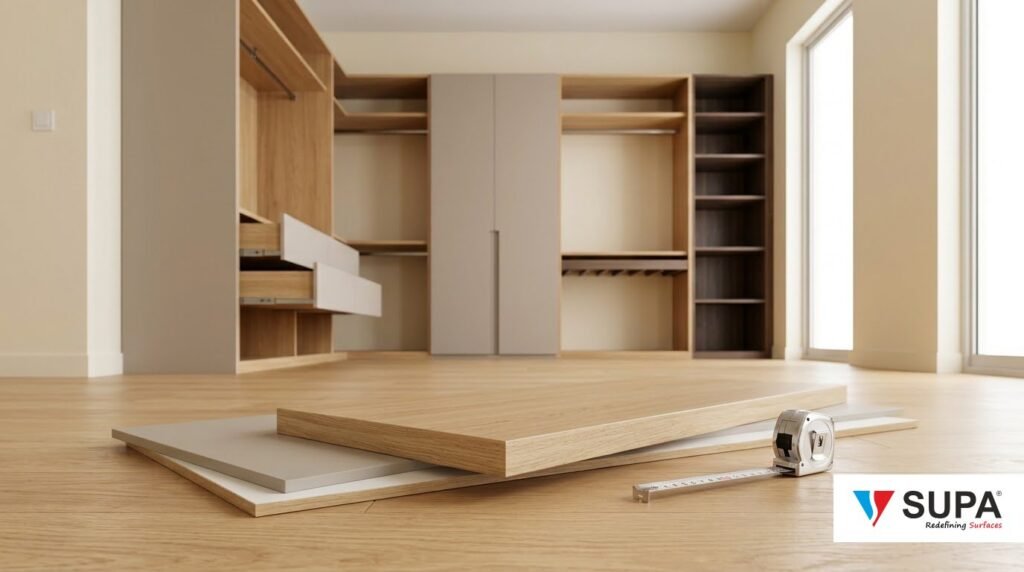
Prelaminated plywood is plywood that arrives from the factory with the decorative laminate layer already bonded to both faces, so your carpenter never has to laminate it on-site.
That single change, laminating at the factory instead of at the workshop, is what makes prelaminated plywood faster to install, more consistent in finish, and often cheaper overall than buying plain plywood and laminate sheets separately and paying labour to bond them.
It has become the default choice for a large share of modular furniture in India for exactly that reason: less site work, fewer finish defects, and a shorter project timeline.
For anyone comparing quotes from two carpenters, understanding what’s actually inside a prelaminated board, and what separates a good one from a poor one, makes it far easier to judge whether a lower quote is a genuine saving or a corner being cut on material quality.
Prelaminated Plywood Saves Both Time and Labour Cost on Site
When plywood and laminate are bonded separately at the carpenter’s workshop, you’re paying for adhesive, press time, and skilled labour on every single panel, and any bubbling or edge lift becomes your problem to fix after installation.
Factory lamination removes that entire step. The board arrives ready to cut and edge-band, which cuts days off a typical wardrobe or kitchen installation and removes one of the most common sources of on-site quality complaints, poor lamination bonding.
For larger projects, this time saving compounds fast. A full home with multiple wardrobes, a kitchen and a study can shave a week or more off the total carpentry schedule simply because the lamination step has already been done before the boards ever reach the site.
There’s a knock-on cost benefit too that often gets overlooked in the initial quote comparison. Skilled lamination labour is one of the harder trades to schedule reliably, and delays waiting for a specific carpenter or press slot can quietly extend a project timeline by days even when every other trade is ready to move. Removing that dependency by sourcing factory-laminated boards keeps the installation schedule in your own control rather than tied to a third party’s availability.
The Finish Quality Is More Consistent Than Site-Laminated Boards
Factory pressing happens under controlled heat, pressure and adhesive dosing every time, which is very difficult to replicate consistently with a manual workshop press. That consistency shows up as fewer visible seams, more even colour matching across a full wardrobe or kitchen run, and a lower defect rate overall.
It’s also why prelaminated plywood is the material of choice for large modular projects such as hotels, offices, and multi-unit residential fit-outs, where dozens of panels need to look identical. A site press, run by hand, will always have small variations in pressure and dwell time between panels, and those variations are exactly what show up later as slightly different sheens or faint bubbling in specific spots.
Best Applications: Wardrobes, Modular Kitchens and Office Furniture
Prelaminated plywood works best anywhere flat panels dominate the design: wardrobe shutters and carcasses, modular kitchen cabinets, office workstations, and partition panels. It’s less suited to curved or highly detailed furniture, where site-applied laminate still offers more flexibility.
Supalam’s prelaminated boards are built on this same principle. The lamination is done to factory tolerances before the board ever reaches a carpenter, which is what keeps installation predictable across a full home or commercial fit-out.
How to Check Prelaminated Plywood Quality Before You Buy
Not all prelaminated boards are made to the same standard, and the differences aren’t always visible at first glance. Check the edges of a sample board closely for any sign of the laminate lifting or a visible glue line; a well-bonded factory panel should show a clean, tight edge with no gap between the laminate and the core.
Ask specifically about the plywood grade underneath the lamination, since a good laminate finish on a poor core is a common way for lower-quality suppliers to cut cost invisibly. BWP or BWR grade cores are worth the small premium for kitchen and bathroom applications, while standard interior grade is generally fine for wardrobes and dry-area furniture.
It’s also worth pressing a thumbnail firmly into an inconspicuous edge of the sample. A properly cured factory laminate won’t dent or lift under that kind of light pressure, while a poorly bonded one sometimes will, which is a useful quick check before committing to a full order.
Prelaminated Plywood vs Prelaminated MDF and Particle Board
Plywood, MDF and particle board can all be prelaminated, and the choice of core material matters as much as the lamination itself. Plywood offers the best screw-holding strength and is generally preferred for load-bearing furniture like cabinet carcasses and shelving that carries real weight.
Prelaminated MDF gives a smoother, more uniform surface that’s popular for flat-fronted modular designs and painted or matte finishes, while particle board sits at the more budget-friendly end and works well for interior panels and lower-load applications where cost control matters more than maximum strength. Supalam’s prelam range spans MDF and particle board cores specifically so a project can match the right substrate to each application rather than defaulting to one core material throughout.
Budgeting for a Prelaminated Plywood Project
Pricing for prelaminated boards is typically quoted per sheet based on thickness, core material and finish, and it’s worth requesting an itemised quote broken down this way rather than a single lump figure for the full project. This makes it far easier to compare quotes across dealers on a like-for-like basis, since two quotes that look similar in total can hide very different core grades or panel counts underneath.
A useful budgeting habit is to calculate material needs room by room before approaching a supplier, listing every wardrobe, cabinet and shelf unit along with its approximate panel count. This avoids the common problem of under-ordering and having to source a top-up batch later, which can introduce a visible shade mismatch if the second batch comes from a different production run. Most established suppliers, including Supalam, can advise on standard sheet sizes and cutting yield to help minimise wastage once the full panel list is finalised, which often saves more on the final bill than negotiating on price per sheet alone.
At a Glance: Comparison Table
| Factor | Prelaminated Plywood | Site-Laminated Plywood |
|---|---|---|
| Lamination location | Factory, under controlled pressure | Workshop, manual press |
| Installation speed | Faster. Ready to cut and edge-band | Slower. Lamination happens after cutting |
| Finish consistency | High. Uniform across panels | Variable. Depends on carpenter skill |
| Common defects | Rare, factory QC controlled | Bubbling, edge lift more common |
| Best for | Wardrobes, modular kitchens, office furniture | Curved or custom-detail furniture |
| Overall cost for large runs | Often lower once labour is included | Higher once labour and rework are included |
Frequently Asked Questions
Is prelaminated plywood the same as laminate sheet?
No. Laminate sheet is the thin decorative surface layer on its own, while prelaminated plywood is a full plywood board that already has that laminate layer factory-bonded to it, ready to cut and use directly.
Is prelaminated plywood waterproof?
Waterproofing depends on the plywood grade underneath the lamination, not the lamination itself, so choose a BWP or BWR grade prelaminated board for kitchens and bathrooms rather than a standard interior grade.
Can prelaminated plywood be used for wardrobe shutters?
Yes, it’s one of the most common uses. The flat panel format and consistent factory finish make it well suited to wardrobe shutters and carcasses across a full modular project.
Does prelaminated plywood need edge banding?
Yes. The laminate covers the face of the board, but the cut edges still need PVC or laminate edge banding to seal the raw plywood core and match the finished surface.
Why choose prelaminated plywood over buying plywood and laminate separately?
Buying separately means paying for site lamination labour and accepting workshop-level finish consistency, while prelaminated plywood arrives ready-bonded at factory quality. That’s why Supalam supplies it as a standard product line rather than leaving lamination to the installation stage.
See Supalam’s prelaminated board range, including the Prelam MDF and particle board lines, in the product catalogue.