
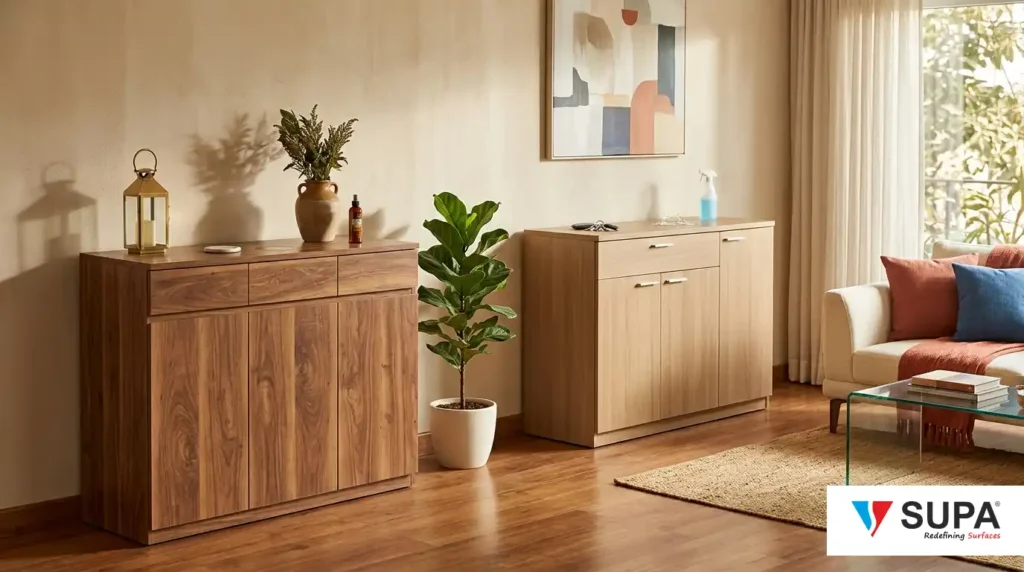
Walk into any furniture showroom and someone will tell you that veneer looks more premium. That advice was reasonable a decade ago when laminates struggled to match the warmth of real wood. Today the gap has closed so significantly that the conversation has changed. For most homes and projects in India, laminates win this comparison on nearly every practical measure.
This is a straight comparison between laminates and veneer across the things that actually matter when you are specifying surfaces for furniture.
What Veneer Is and Why People Like It
Veneer is a thin slice of real wood, usually between 0.5 mm and 2 mm thick, pressed onto a plywood or MDF core. Because it uses genuine wood, it carries natural grain variation, warmth, and a sense of authenticity that laminates have historically tried to replicate rather than match. That authenticity is still the primary reason people choose it.
Veneer is popular in premium residential furniture, high-end hospitality projects, and spaces where the material story matters to the client. The problem is that real wood reacts to its environment. In Indian climates where humidity fluctuates, veneer can swell, crack at edges, and peel at joints. It also requires regular waxing or lacquering to hold its appearance.
Why Laminates Have Changed the Conversation
Modern decorative laminates are engineered composite sheets made by pressing layers of kraft paper, resins, and a decorative surface under high heat and pressure. The result is a surface that is harder, more dimensionally stable, and far more resistant to wear than veneer.
The design technology has moved substantially forward. Today’s wood finish laminates replicate the grain, texture, and depth of teak, walnut, oak, and wenge in a way that surprised even experienced interior designers when they first encountered premium options. Supalam’s wooden finish collection captures this authenticity while removing veneer’s core weakness, which is its vulnerability to moisture and surface damage.
That is not a sales claim. It is what happens when you compare the maintenance records of both materials across installed projects over five to ten years.
Direct Comparison Across What Actually Matters
| Factor | Laminates | Veneer |
|---|---|---|
| Material composition | Engineered layers of paper, resin, and decorative surface | Real wood slice 0.5 to 2 mm thick |
| Cost in India | Rs. 30 to Rs. 150 per sq ft | Rs. 150 to Rs. 500 per sq ft |
| Moisture resistance | High, suitable for kitchens and bathrooms | Low, prone to swelling and peeling |
| Scratch resistance | High in HPL grades | Medium, scratches show clearly |
| Maintenance | Wipe clean, no polishing needed | Regular waxing and lacquering required |
| Design options | Gloss, matt, textured, wood, stone, digital print | Limited to natural wood grains |
| Installation skill needed | Standard adhesive bonding | Requires experienced carpenter |
| Average lifespan | 10 to 15 years with normal care | 8 to 12 years with careful maintenance |
| Humidity tolerance | High, dimensionally stable | Low, reacts to humidity changes |
Where Veneer Still Makes Sense
Veneer remains the right call when authenticity is genuinely non-negotiable for the brief. Luxury hotels, boutique restaurants, executive boardrooms, and statement residential pieces where the client wants real wood under their fingertips are valid applications. The material story carries real weight in those contexts.
If the brief and the budget both support veneer, it is a legitimate choice. But that is a specific and fairly narrow use case when you look at the full range of furniture projects being done across India.
Where Laminates Win Without Qualification
Modular kitchens, wardrobes, TV units, study tables, office furniture, retail fixtures, and high-traffic commercial interiors are all spaces where laminates outperform veneer on every practical metric. Supalam’s range covers all these applications with options across gloss, matt, textured, and digital print categories.
The Acryglem and Unitop lines handle premium applications where aesthetics and durability both matter. For kitchen-specific requirements, the Kitchen Laminates range addresses heat, moisture, and stain resistance as a combined package rather than making you choose between them.
A Note on Sustainability
More designers are weighing this for 2026 projects. Laminates use wood pulp, often from recycled or plantation sources, which is more resource-efficient than slicing old-growth or plantation timber into veneer sheets. For projects with green building requirements or LEED targets, laminates are the more defensible choice when it comes to material sourcing documentation.
The Bottom Line
For 95 percent of residential and commercial furniture projects in India, laminates offer a better combination of cost, durability, design range, and ease of maintenance than veneer. Veneer earns its place in luxury applications where the authentic material story is the brief. Outside of that context, laminates are the smarter specification.
If you are planning a furniture project and want to see what current laminates actually look like across wood finishes, gloss, matt, and textured options, the Supalam catalogue is worth going through before you make a final material call.
Browse Supalam’s Full Range at supalam.com | Wooden Finish, Acryglem, Unitop, Kitchen Laminates, e-Catalogue
Frequently Asked Questions
Which is better for kitchen cabinets, laminate or veneer?
Laminates are the better choice for kitchen cabinets. They handle moisture, heat, and daily contact better than veneer, which can swell or peel in humid kitchen conditions. Laminates also cost considerably less and clean up with just a damp cloth.
Is veneer more durable than laminate?
Not for most Indian home conditions. High pressure laminates match or exceed veneer durability in practical use. Veneer is real wood and needs regular waxing and careful maintenance to hold its finish, while laminates stay in good condition with minimal effort.
Can laminates look like real wood?
Yes. Modern wood finish laminates replicate teak, oak, walnut, and wenge grain patterns with high accuracy. Supalam’s wooden finish range delivers that natural look without the upkeep cost that real veneer requires.
What is the price difference between laminates and veneer in India?
Laminates typically range from Rs. 30 to Rs. 150 per square foot depending on grade and thickness. Natural veneer starts from Rs. 150 and can go much higher. For large furniture projects, laminates offer a significantly better cost-to-quality ratio.
Which lasts longer on furniture, laminate or veneer?
A well-applied laminate sheet from a quality manufacturer lasts 10 to 15 years with basic care. Veneer, though beautiful, is thinner and more vulnerable to peeling, fading, and moisture over time. In Indian climates with humidity variation, laminates hold up more reliably.