
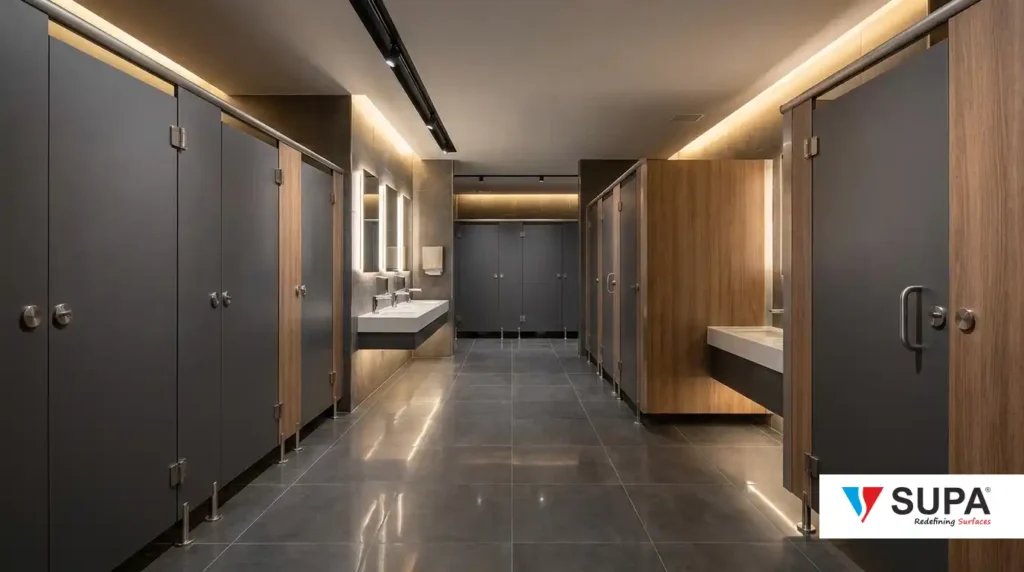
Compact HPL (High-Pressure Laminate) is mentioned regularly in architectural specifications for institutional and commercial projects, yet most homeowners and many contractors have little understanding of what separates it from the decorative laminate sheets used in residential furniture. The two products share a name but have very different compositions, performance characteristics, and appropriate uses.
This guide explains compact HPL clearly: what it is made of, what it can do that standard decorative laminate cannot, which applications actually require it, and what to look for when specifying it for a project in India.
Compact HPL vs Decorative HPL: The Fundamental Difference
A standard decorative HPL sheet (the 1mm laminate used on wardrobes and kitchen shutters) consists of several layers of kraft paper impregnated with phenol resin, topped with a printed decorative layer and a protective overlay. The total thickness is 0.8mm to 1mm+ and the sheet is designed to be bonded to a separate substrate like MDF or plywood during fabrication.
Compact HPL is built from the same raw material resin-saturated kraft paper but with one critical difference: it is manufactured in much greater thickness (typically 6mm to 25mm), with all layers being structural kraft-phenol paper rather than a thin decorative surface on a thick base. The result is a self-supporting panel that does not need a separate substrate to function structurally.
In compact HPL, the material itself is the structure. You can machine it, drill it, cut it, and mount it directly without bonding it to anything. It is a laminate panel, not a laminate sheet.
| Property | Decorative HPL Sheet | Compact HPL Panel |
|---|---|---|
| Thickness range | 0.8mm – 1.5mm | 6mm – 25mm (standard range) |
| Self-supporting | No requires substrate bonding | Yes structurally independent |
| Water resistance | MR grade (moisture resistant) | Fully waterproof used in wet areas without substrate |
| Impact resistance | Moderate | Very high designed for vandal-resistance applications |
| Surface both sides | Usually one decorated side | Both faces decorated used as visible panel from both sides |
| Applications | Furniture shutters, wall panels, table tops (bonded) | Toilet cubicles, laboratory tops, locker systems, exterior cladding |
| Price range (India) | Rs 30–250/sq ft | Rs 250–700+/sq ft depending on thickness and grade |
| Bonding requirement | Requires substrate + adhesive | Mounted with mechanical fixings or edge-to-edge joinery |
Why Compact HPL Is Specified for Institutional and Commercial Projects
Three properties of compact HPL make it the mandatory specification in certain applications:
1. Self-Contained Waterproofing
In a standard toilet partition system, MDF panels with a laminate surface will fail within two to three years in a well-used washroom. The substrate absorbs moisture from mop water, condensation, and overflow. Once MDF absorbs moisture, it swells, the laminate lifts, and the panel degrades structurally. Compact HPL eliminates the substrate entirely. The panel is the same material throughout fully waterproof, non-swelling, and dimensionally stable in wet environments.
This is why toilet cubicle partitions, hospital washroom partitions, and commercial restroom systems are almost universally specified in compact HPL in India’s institutional sector. The material cost is higher but the lifecycle cost is far lower than MDF-based systems that require replacement.
2. Impact and Vandal Resistance
Public spaces school locker rooms, railway station washrooms, airport facilities, stadium changing rooms subject furniture panels to deliberate impact, graffiti, and abusive use patterns that no domestic furniture is designed for. The solid cross-section of compact HPL provides impact resistance that no laminate-over-substrate system can match. The material does not dent from impact because there is no air or lower-density core to compress.
Compact HPL surfaces can also be cleaned with industrial disinfectants, bleach-based cleaners, and steam cleaning without surface degradation. MDF-backed decorative laminates cannot withstand this cleaning regime.
3. Exterior Cladding Grade
Certain compact HPL products are formulated and tested for exterior facade applications outdoor signage, building cladding panels, exterior canopies, and weather-exposed screen walls. These grades carry UV-stable overlays and are tested for dimensional stability under temperature cycling, moisture cycling, and UV exposure. Standard decorative HPL is not rated for exterior exposure.
Applications Where Compact HPL Is the Right Specification in India
| Application | Why Compact HPL | Recommended Thickness |
|---|---|---|
| Toilet and washroom cubicles (commercial) | Wet environment, high traffic, cleaning chemicals | 12mm – 13mm |
| Laboratory benchtops and worktops | Chemical resistance, cleanable surface, structural strength | 12mm – 20mm |
| Lockers and changing room systems | Impact resistance, moisture resistance, vandal resistance | 10mm – 13mm |
| Hospital furniture and clinical areas | Hygienic, cleanable with disinfectants, no substrate to delaminate | 10mm – 13mm |
| Exterior architectural cladding | UV stability, weather resistance, dimensional stability | 6mm – 10mm (exterior grade) |
| School furniture (high traffic) | Impact resistance, durability over multiple student generations | 10mm – 12mm |
| Canteen and cafeteria tabletops | Heavy use, cleanable, moisture resistant | 12mm – 16mm |
Where Compact HPL Is NOT the Right Answer
Compact HPL is sometimes recommended by dealers for standard residential applications kitchen shutters, wardrobe doors, and furniture panels where it provides no meaningful advantage over standard 1mm decorative HPL at a significant cost premium. Unless an application specifically requires the waterproof core, structural self-support, or impact resistance of compact HPL, standard HPL on a proper substrate is the more cost-effective and practical specification.
Compact HPL is also more difficult to work with for most Indian carpenters and furniture fabricators because it requires diamond-tipped cutting tools, drilling parameters appropriate for the material density, and edge treatment approaches different from those used for standard laminate. Recommending compact HPL to a fabricator unfamiliar with the material adds cost and execution risk without adding benefit for residential applications.
How to Read a Compact HPL Specification
When an architectural specification document references compact HPL, look for these parameters to confirm the right product is being sourced:
- Thickness: The specified thickness determines structural span capability and application suitability. Toilet partitions typically require 12mm minimum. Exterior cladding typically specifies 6mm to 8mm in a ventilated system.
- Surface finish: Both faces should be decorated for partition applications. One face decorated is used for worktops and shelving where the underside is not visible.
- Grade designation: Exterior-grade compact HPL carries different overlay specifications and UV resistance ratings compared to interior-grade. Do not substitute interior grade for an exterior specification.
- IS/EN standard reference: Quality compact HPL in the Indian market is tested to EN 438 (European standard for HPL) or ISO 4586 standards. Ask for compliance documentation.
- Edge treatment method: Cut compact HPL edges expose the cross-section of alternating paper layers, which is visually distinct. Edges can be chamfered, banded with matching compact HPL strips, or left visible depending on the application and design intent.
Frequently Asked Questions
Q1. Is compact HPL the same as phenolic board?
Compact HPL and phenolic board are terms used interchangeably in the Indian market, though technically phenolic board refers specifically to the dark brown kraft-phenol construction without a decorative overlay. In most commercial specifications, compact HPL refers to the decorated version (one or both faces carry a decorative surface). The structural core of both is the same: densely compressed resin-saturated kraft paper.
Q2. Can compact HPL be used for kitchen countertops?
Yes. Compact HPL at 12mm or above is an appropriate countertop material and is used in commercial kitchen surfaces, canteen counters, and laboratory benches. For residential kitchen counters in India, granite and engineered stone remain more common because of cost and aesthetic preference, but compact HPL countertops are a legitimate specification for contemporary kitchens where a non-stone surface is preferred.
Q3. How does compact HPL compare to solid wood for toilet partitions?
Compact HPL significantly outperforms solid wood and wood-based panels in toilet partition applications. Wood, plywood, and MDF-based systems absorb moisture over time regardless of surface treatment, leading to warping, swelling, and structural failure. Compact HPL remains dimensionally stable in wet environments indefinitely and resists the cleaning chemicals used in institutional washrooms. In commercial projects, the lifecycle cost of compact HPL partitions is substantially lower than wood-based systems.
Q4. What thickness of compact HPL is used for toilet partitions in India?
The standard specification for toilet cubicle partitions in Indian commercial projects is 12mm to 13mm compact HPL. This thickness provides the structural rigidity for free-hanging door panels and partition walls without floor-to-ceiling support. Some premium specifications use 16mm for additional rigidity and acoustic performance. For overhead panels and lightweight dividers, 10mm is used.
Q5. Is compact HPL available from Indian manufacturers or only imported?
Both domestic and imported compact HPL is available in India. Domestic manufacturers produce compact HPL for the institutional and commercial market. Premium exterior-grade compact HPL for architectural facade applications is typically sourced from European manufacturers with established track records in weathering performance. For standard interior institutional applications, quality domestic compact HPL is available and appropriate.
Q6. Does compact HPL require a special adhesive?
Compact HPL used as a countertop or bonded wall panel does require a structural contact adhesive appropriate for HPL bonding. For toilet partition systems and locker assemblies, the panels are typically mounted with mechanical fixings (stainless steel bolts and brackets) rather than adhesive bonding. The installation method depends on whether the compact HPL is being used as a surface overlay, a free-standing panel, or a mounted partition system. Always confirm the fixing method with the manufacturer’s installation guidelines.