
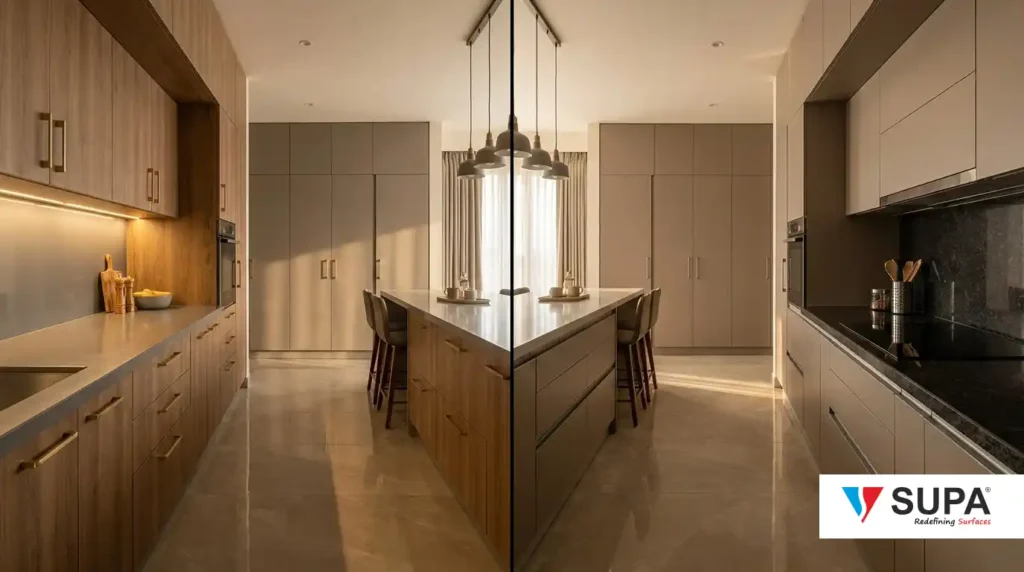
PVC boards have grown significantly in the Indian modular furniture market over the past five years. Dealers position them as a modern, waterproof alternative to laminate-finished plywood or MDF. The marketing is effective, and it has created real confusion among homeowners and even among contractors who are not working with both materials regularly.
The honest comparison is more nuanced than the ‘waterproof vs not waterproof’ framing that most PVC advocates use. Both materials have legitimate applications. Both have failure modes that are not typically disclosed at the point of sale. This guide works through the comparison with the specificity that a genuine purchase decision requires.
What PVC Boards Actually Are and How They Differ From Laminated Furniture Boards
PVC (polyvinyl chloride) boards for furniture are hollow or foam-core plastic sheets extruded to furniture panel dimensions. They are manufactured in standard thicknesses of 12mm, 16mm, and 18mm, matching the substrate dimensions used in conventional modular furniture. The surface is either the raw PVC finish or, in most products available in the Indian market, a thin PVC film or foil bonded to the face.
Laminated furniture boards are manufactured from a structural substrate plywood, MDF, or particle board with a decorative HPL sheet bonded to the surface. The substrate provides structural rigidity and screw-holding strength. The laminate provides the surface finish, scratch resistance, and aesthetic range.
These are fundamentally different structural propositions. PVC boards are a single homogenous material. Laminated boards are a composite a structural layer and a surface layer working together. This distinction determines how each material performs in practice.
Side-by-Side Performance Comparison
| Factor | Laminate on MDF/Plywood | PVC Board |
|---|---|---|
| Moisture resistance | MR grade: resistant, not waterproof. Edge sealing critical. | Fully waterproof core does not absorb water |
| Structural strength | High plywood and MDF have excellent load-bearing capacity | Moderate hollow or foam core has lower load capacity |
| Screw holding strength | Excellent in plywood, good in MDF | Poor to moderate screws pull out under load over time |
| Surface hardness | High HPL surface resists scratches and indentation | Low to moderate PVC film scratches easily |
| Heat resistance | High handles kitchen proximity heat | Low PVC warps and softens above 50-60 degrees Celsius |
| Design variety | Thousands of finishes, textures, and custom digital prints | Limited standard solid colours and basic woodgrains |
| Cost (per sq ft, full panel) | Rs 90–250 (substrate + laminate + edge band) | Rs 180–350 (PVC board including surface film) |
| Weight | Heavier plywood is dense | Lighter hollow or foam core reduces weight |
| Environmental considerations | Substrate from certified wood sources available | PVC is non-biodegradable, limited recycling infrastructure in India |
| Longevity (typical Indian conditions) | 10–15 years with proper installation | 5–10 years before surface film peeling and fastener failure |
Where PVC Boards Perform Well and Where They Fail
Applications Where PVC Boards Are Genuinely Appropriate
PVC boards are legitimately useful in environments with direct and sustained water exposure. Bathroom vanity carcasses that sit on wet floors, laundry area shelving, outdoor covered furniture, and any substrate that will be continuously exposed to moisture are appropriate applications. The waterproof core property is a genuine advantage in these cases that laminate-over-MDF cannot match.
For rental properties and budget projects where the primary concern is moisture resistance and not long-term structural performance, PVC provides an economical option for carcass panels in bathrooms and utility areas. The limited design range is less of a concern in these contexts.
Where PVC Boards Fail in Practice
The two most common PVC board failure modes in Indian residential projects are screw pull-out and surface film peeling.
PVC board carries screws through friction only, not into a grain structure the way wood-based boards do. Hinge screws and drawer slide screws in PVC boards pull out under the daily load of opening and closing, typically within three to five years. Carpenters familiar with wood-based boards often overtighten these fixings, which accelerates the failure. There is no reliable repair the panel needs replacement.
The surface film on most PVC boards available in the Indian market is a thermally laminated PVC foil, not a pressed HPL surface. This film peels at edges and corners when exposed to kitchen heat, cleaning chemicals, or sustained humidity variation. Once peeling starts, it accelerates rapidly because the exposed edge allows moisture under the film layer.
Kitchen proximity is the most critical failure risk. PVC boards soften and deform at temperatures above 50 to 60 degrees Celsius. Gas stove proximity, oven placement, and even hot utensils placed on adjacent surfaces create sustained heat that causes PVC to warp. HPL laminate on plywood handles these temperatures without deformation.
Kitchen Cabinet Specification: The Application That Decides Most Buyers
Kitchen cabinets are where the laminate vs PVC debate plays out most frequently in India, and the comparison outcome is clear for most residential kitchen applications.
| Kitchen Cabinet Application | Recommended Material | Reason |
|---|---|---|
| Lower carcass (base units) | 18mm BWR plywood + 1mm laminate | Load-bearing; carries weight of countertop, appliances, stored utensils |
| Upper cabinet carcass | 18mm MDF or plywood + 0.8mm laminate interior | Structural, not weight-critical; laminate interior finish |
| Shutter doors (lower) | 18mm MDF + 1mm+ kitchen laminate | Daily contact zone; HPL scratch and heat resistance essential |
| Shutter doors (upper) | 18mm MDF + 1mm laminate or acrylic-finish | Less contact; design finish can be prioritised |
| Sink cabinet carcass | 18mm BWP plywood + laminate OR PVC board | Under-sink area sees high moisture; PVC is legitimate here |
| Internal shelves | Prelam MDF or particle board | Non-visible; economy specification appropriate |
The sink cabinet carcass is the one application where PVC board or compact HPL genuinely outperforms standard MDF laminate in a kitchen. The under-sink space in most Indian kitchens has poor ventilation and periodic water exposure from plumbing connections. MDF in this location will swell and fail within a few years regardless of how well the laminate is applied. Either BWP (Boiling Water Proof) plywood or PVC board is the correct specification here.
Wardrobe Specification: Why Laminate Remains the Right Answer
For wardrobes, PVC boards offer no meaningful advantage over laminate-on-MDF and carry real disadvantages. Bedrooms do not have the sustained moisture exposure that warrants PVC’s waterproof property. Wardrobes carry significant clothing weight on hanging rails and shelves, where PVC’s lower structural strength and poor screw retention create long-term problems. The design range available in HPL for wardrobes from deep woodgrain textures to premium mattes to high-gloss accent panels is vastly superior to what PVC surface films offer.
A well-specified wardrobe uses 18mm MDF carcass with 0.8mm laminate interior, 1mm HPL on all visible external surfaces, and colour-matched edge band. This specification will outlast any PVC board wardrobe in the same environment and provides dramatically more design flexibility.
The Cost Reality: Which Is Actually Cheaper?
Dealers frequently position PVC boards as a cost-saving alternative to laminate furniture. The full installed cost comparison is more nuanced.
A standard laminate-on-MDF panel (18mm MDF substrate + 1mm HPL sheet + edge band application) in 2026 runs approximately Rs 180 to 280 per square foot of finished panel, depending on the laminate grade and region. A comparable PVC board panel with surface film costs approximately Rs 200 to 350 per square foot for the board alone, without factoring in the higher hardware costs required to compensate for poor screw retention (longer screws, inserts, or specialised fixings).
Over a 10-year lifecycle, laminate-on-MDF or plywood has significantly lower total cost because it does not require the panel replacements that PVC board typically needs at the five to seven year mark due to screw pull-out and surface film failure.
Frequently Asked Questions
Q1. Is PVC board really waterproof?
The PVC core is waterproof, meaning the substrate itself will not swell or absorb moisture. However, the surface film on most PVC furniture boards available in India is a thermally laminated foil that is not as moisture-resistant as the core. Prolonged water contact at edges or joints can cause this film to lift. The core is also prone to delaminating from the film in high-heat environments. Calling PVC board ‘fully waterproof’ is accurate for the core but misleading for the finished panel in all conditions.
Q2. Which is better for kitchen cabinets laminate or PVC?
For most of the kitchen, laminate on quality plywood or MDF is the better specification. It is structurally stronger, holds hardware better, handles heat, and offers far more design options. The one exception is the sink cabinet carcass, where sustained moisture exposure makes PVC board or BWP plywood a more appropriate choice than MDF.
Q3. Can PVC board be used for wardrobe carcasses?
It can be used, but it is not the recommended specification. Wardrobes carry significant weight and the hardware (hinges, drawer slides, rail brackets) relies on consistent screw retention over years of daily use. PVC board’s poor screw holding strength means that hardware will loosen and fail before the surface shows wear. For wardrobes, 18mm MDF or 18mm plywood with laminate is the better choice.
Q4. What is the thickness of PVC boards used in Indian furniture?
The standard thicknesses available in India are 12mm, 15mm, 16mm, and 18mm. For structural panel applications (carcass sides, shelves, door panels), 18mm is the minimum. 12mm and 15mm are used for back panels and non-load-bearing internal partitions. The density and composition of PVC boards varies significantly between manufacturers always check the sheet weight (denser boards have better screw retention) rather than relying on thickness alone.
Q5. How do I know if a laminate sheet is genuinely MR grade?
An MR (Moisture Resistant) grade HPL sheet meets the IS 2046 soak test requirement where the sheet shows no delamination after immersion in water for specified periods. Look for the IS 2046 certification marking on the sheet backing. For kitchen applications, IS 2046 MR grade is the minimum required specification. Some premium ranges carry additional testing certifications for higher-demand moisture environments.
Q6. What is prelam board and is it different from PVC board?
Prelam (pre-laminated) board is an MDF or particle board substrate with a low-pressure laminate (LPL) surface fused onto it at the factory. It is a wood-based product, not a plastic product. Prelam boards are used extensively in modular furniture carcasses and shelving as an economical alternative to site-applied HPL. They are entirely different from PVC boards in composition, performance characteristics, and appropriate applications.