
If you have ever sat with a carpenter or a furniture vendor going through material options, you have almost certainly hit this question , particle board or MDF? Both come pre-laminated, both look similar on the surface, and both are used daily by furniture makers across India. But they are genuinely different materials, and picking the wrong one for the wrong job costs money and causes problems down the line.
Here is a plain-language breakdown of what each board is, where it works, and where it falls short. We will also tell you exactly what Supalam recommends for common furniture applications.
What is the Prelam Particle Board?
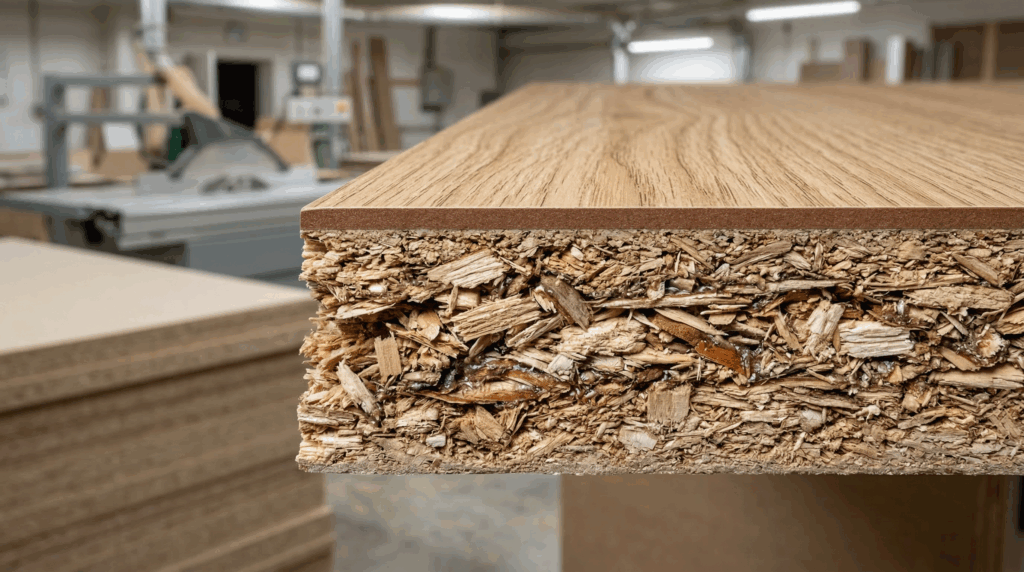
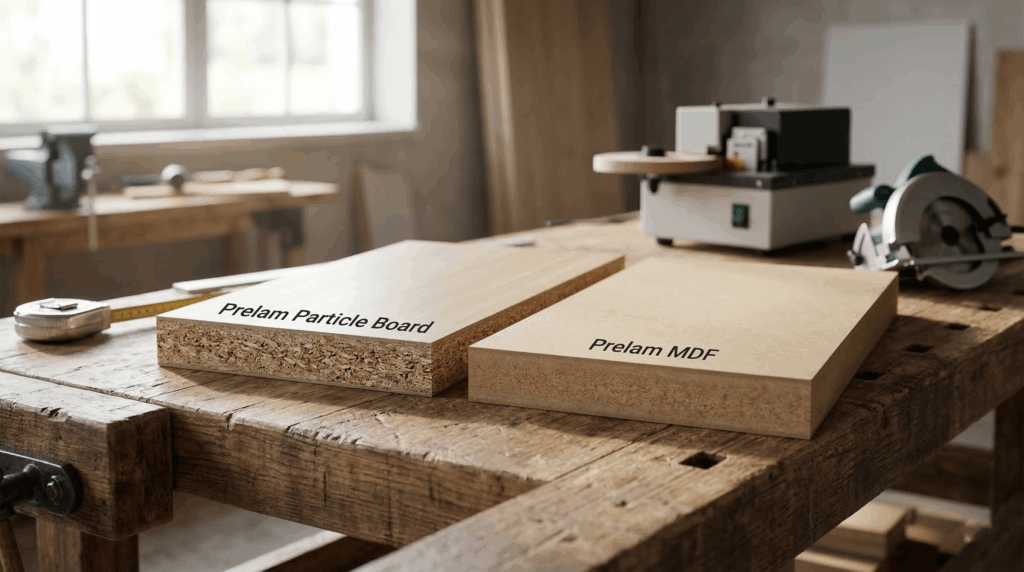
Particle board is made from wood chips, sawdust, and shavings that are compressed together with resin under heat and pressure. The “prelam” version simply means the decorative laminate surface has been applied at the factory , so you get a board that is ready to cut and use without any additional finishing.
It is lighter than MDF, less expensive, and widely available across India from 12mm to 25mm thickness. For a lot of furniture applications, it does the job perfectly well.
Where it works well:
- Back panels and bottom panels of wardrobes
- Fixed shelves and storage units in dry rooms
- Office furniture that does not need edge profiling
- Budget projects where cost control is the main brief
- Bulk supply for large housing or commercial fit-out projects
What is Prelam MDF?
MDF , Medium Density Fibreboard , is made from much finer wood fibres. The result is a denser, smoother, and more uniform panel. Like particle board, the prelam version comes with the laminate already applied.
The difference you notice immediately when you work with MDF is the surface quality and how cleanly the edges behave. MDF machines work well, take edge banding neatly, and CNC routers love it. It is the material of choice for any furniture where the finish and the edges are going to be seen up close.
Where it works well:
- Modular kitchen cabinet shutters and carcasses
- Wardrobe doors , particularly designs with routed or profiled edges
- Any furniture with CNC detailing
- High-end residential and commercial interiors
- Wet-area furniture when used in the moisture-resistant (MR) grade
How Do They Actually Compare?
| Parameter | Prelam Particle Board | Prelam MDF | Better Option |
| Surface smoothness | Good | Excellent , very consistent | MDF |
| Edge quality | Needs edge banding, can chip | Clean, CNC-friendly edges | MDF |
| Screw holding on face | Good | Excellent | MDF |
| Screw holding on edge | Average | Good | MDF |
| Moisture resistance | Standard only | MR grade available | MDF (MR grade) |
| Weight | Lighter | Heavier | Particle Board |
| CNC routing | Limited , tends to chip | Works very well | MDF |
| Cost (approx.) | Rs. 4065 per sq ft | Rs. 5585 per sq ft | Particle Board |
| Best application | Back panels, shelving, budget work | Kitchen cabinets, modular furniture | Depends on the job |
Mistakes People Make When Choosing
A few patterns come up again and again when things go wrong with board selection:
- Using standard particle board for kitchen cabinets. Kitchens have moisture, steam, and occasional water spills. Standard particle boards absorb moisture at the joints and start swelling within a year or two.
- Paying for MDF on back panels that no one will ever see. It adds cost without adding anything the end customer benefits from.
- Not checking whether the board is HPL or LPL laminated. HPL holds up to daily use; LPL is thinner and more vulnerable. Always confirm before ordering.
- Skipping edge banding on particle board edges. Those raw edges are the first thing that absorbs moisture and the first thing that chips.
- Ignoring thickness tolerance. A 1mm variation sounds small but causes real fitting problems in modular systems where everything needs to line up precisely.
What Supalam Recommends
For most professional furniture projects, the practical answer is to use both boards in the same piece of furniture , each where it makes sense.
- Supa Pre-Lam Boards for back panels, fixed shelves, concealed structural elements, and budget applications where the surface will not take daily wear.
- Supalam Prelam MDF for any surface the client will see or touch , kitchen shutters, wardrobe doors, CNC-profiled elements, and anything in a wet or high-humidity area.
Many furniture manufacturers and interior contractors working across Delhi NCR, Haryana, and UP do exactly this; they source both from Supalam and use each where it belongs. One supplier, matched decor codes, no colour inconsistency between the two boards.
Supalam manufactures both Supa Pre-Lam Boards and Prelam MDF at its Muzaffarnagar facility. Both are available in matching finishes, which means your edge bands, laminates, and boards all coordinate without any guesswork.
Common Questions
Can particle board be used in kitchens at all?
For the cabinet carcass in a dry, well-ventilated kitchen with no direct water exposure, good-quality particle board can work. But for any surface near the sink, below the cooktop, or in a kitchen with regular steam , MR-grade MDF is the right call. The few hundred rupees saved on the board are not worth the call-back two years later.
What is the actual price difference?
Prelam particle board typically lands between Rs. 40 and Rs. 65 per square foot depending on thickness and finish. Prelam MDF runs Rs. 55 to Rs. 85. The gap is real but not dramatic , and for customer-facing surfaces, MDF earns back the difference in quality perception.
Does Supalam supply both boards directly to furniture manufacturers?
Yes. Both Supa Pre-Lam Boards and Prelam MDF Boards are available directly from Supalam for manufacturers, dealers, and contractors across Delhi NCR, Haryana, and UP. Call or email for trade pricing and samples.
Explore Supa Pre-Lam Boards and Prelam MDF at supalam.com/products or call +91 989905 4064 for trade enquiries.