
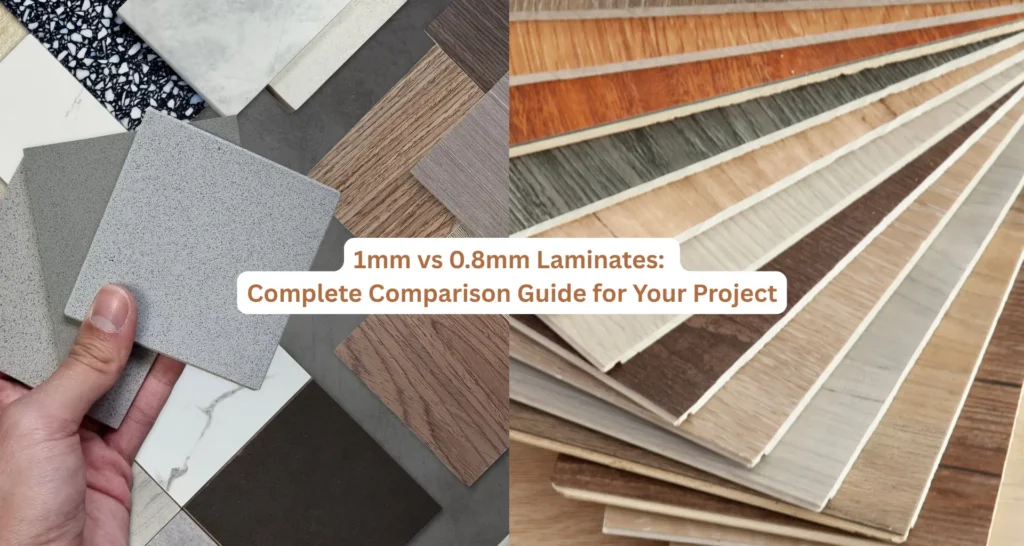
One of the most common questions homeowners and interior designers face when selecting laminates is: “Should I choose 1mm or 0.8mm thickness?” While the 0.2mm difference might seem minimal, it significantly impacts durability, cost, appearance, and suitability for different applications.
This comprehensive guide breaks down everything you need to know about laminate thickness, helping you make an informed decision that balances quality, budget, and specific project requirements.
Understanding Laminate Thickness
Before diving into comparisons, let’s understand what laminate thickness actually means and why it matters.
What is Laminate Thickness?
Laminate thickness refers to the total thickness of the decorative surface layer that’s applied to your furniture or wall panels. This measurement includes:
- Decorative paper layer: Contains the design/pattern
- Overlay or wear layer: Protective transparent top layer
- Kraft paper layers: Core layers providing stability and thickness
- Backing: Base layer for adhesion
Why Thickness Matters
Thickness affects:
- Durability: Thicker laminates withstand more wear and tear
- Impact resistance: Better protection against dents and damage
- Heat resistance: Greater thickness provides more thermal protection
- Appearance: Thicker laminates often have better depth and clarity
- Cost: Thicker means more material, hence higher price
- Application suitability: Different uses require different thickness levels
Detailed Comparison: 1mm vs 0.8mm Laminates
Physical Specifications
1mm Laminates:
- Exact Thickness: 0.9mm – 1.0mm (typically labeled as 1mm)
- Weight: Approximately 1.5 kg per square meter
- Kraft Paper Layers: 4-5 layers
- Density: Higher density, more compact
0.8mm Laminates:
- Exact Thickness: 0.7mm – 0.8mm
- Weight: Approximately 1.2 kg per square meter
- Kraft Paper Layers: 3-4 layers
- Density: Slightly lower density
Durability Comparison
1mm Laminates – Superior Durability:
Advantages:
- Better scratch resistance in daily use
- Higher impact resistance
- Longer lifespan (15-20 years vs. 10-15 years)
- Better edge stability
- Less prone to chipping
Real-World Performance:
- Handles kitchen cabinet use for 15+ years
- Withstands children’s room abuse
- Performs well in commercial settings
- Better suited for furniture that’s moved frequently
0.8mm Laminates – Adequate for Most Uses:
Advantages:
- Sufficient for low-traffic areas
- Good for temporary installations
- Adequate for rental properties
- Suitable for budget projects
Real-World Performance:
- Works well for bedroom wardrobes (light use)
- Good for office cabinets (moderate use)
- Suitable for interior shelving
- May show wear faster in high-traffic areas
Verdict: If longevity is priority, 1mm is the clear winner.
Heat Resistance
1mm Laminates:
- Heat Tolerance: Up to 180-200°C
- Recovery Time: Better heat dissipation
- Resistance to Heat Marks: Superior
- Best For: Kitchen countertops (with trivets), near-stove cabinets
0.8mm Laminates:
- Heat Tolerance: Up to 150-170°C
- Recovery Time: Slower heat dissipation
- Resistance to Heat Marks: Moderate
- Best For: Areas away from heat sources
Critical Note: Regardless of thickness, NEVER place hot vessels directly on laminates. Always use trivets or hot pads.
Verdict: 1mm provides better heat protection, crucial for kitchens.
Moisture Resistance
1mm Laminates:
- Core Density: Higher density = less moisture absorption
- Edge Stability: Less swelling when exposed to moisture
- Recovery: Better bounce-back after moisture exposure
- Application: Can handle moderate moisture if edges are sealed
0.8mm Laminates:
- Core Density: Lower density = slightly higher absorption
- Edge Stability: More susceptible to edge swelling
- Recovery: May remain swollen after moisture exposure
- Application: Keep away from direct water contact
Important: Both require proper edge sealing to prevent moisture damage.
Verdict: 1mm offers better moisture resistance, important for kitchens and bathrooms.
Cost Comparison
Price Difference (2026 Market Rates):
1mm Laminates:
- Standard Designs: ₹900-1,500 per sheet (8×4 ft)
- Premium Designs: ₹1,500-2,500 per sheet
- Per Square Foot: ₹140-200
0.8mm Laminates:
- Standard Designs: ₹600-1,000 per sheet (8×4 ft)
- Premium Designs: ₹1,000-1,800 per sheet
- Per Square Foot: ₹95-150
Cost Difference: Approximately 30-40% cheaper for 0.8mm
Cost-Benefit Analysis:
For a 10×10 Modular Kitchen:
- 1mm Laminates Total: ₹25,000-35,000
- 0.8mm Laminates Total: ₹18,000-25,000
- Savings with 0.8mm: ₹7,000-10,000
Long-Term Value:
- 1mm: Higher initial cost, longer life = lower cost per year
- 0.8mm: Lower initial cost, shorter life = may need replacement sooner
Verdict: 0.8mm wins on immediate cost, 1mm wins on long-term value.
Appearance and Finish Quality
1mm Laminates:
Visual Quality:
- Design Clarity: Sharper, more defined patterns
- Color Depth: Richer, more vibrant colors
- Texture Reproduction: Better detail in textured finishes
- 3D Effects: More pronounced depth
Professional Appearance:
- Looks more substantial
- Premium feel
- Better for high-end projects
- Matching edge bands look more seamless
0.8mm Laminates:
Visual Quality:
- Design Clarity: Good but slightly less sharp
- Color Depth: Adequate color vibrancy
- Texture Reproduction: Less pronounced texture
- 3D Effects: Moderate depth
Professional Appearance:
- Adequate for most applications
- May look slightly thinner on edges
- Good for budget-conscious quality projects
- Edge banding may be more visible
Verdict: 1mm provides superior visual quality and finish.
Installation Considerations
1mm Laminates:
Installation Process:
- Adhesive Requirements: Standard contact adhesive works well
- Handling: More rigid, less prone to bending during installation
- Cutting: Requires sharper blades, more careful cutting
- Edge Finishing: Cleaner edge cuts
- Wastage: Typically 10-12%
Installer Preference: Preferred by professional installers for easier handling
0.8mm Laminates:
Installation Process:
- Adhesive Requirements: Same as 1mm
- Handling: More flexible, requires careful handling to prevent bending
- Cutting: Easier to cut, less blade wear
- Edge Finishing: Edges may be more fragile
- Wastage: Typically 12-15% (more breakage)
Installer Preference: Can be trickier for inexperienced installers
Verdict: 1mm is easier to install professionally.
Application-Specific Recommendations
When to Choose 1mm Laminates
Essential for:
- Kitchen Cabinets (especially near stove/sink)
- Kitchen Countertops (with HPL grade)
- Bathroom Vanities
- Children’s Furniture
- Commercial Spaces (offices, shops, showrooms)
- High-Traffic Areas
- Furniture Subject to Daily Use
- Display Units in Living Areas
- Study Tables and Work Desks
- Wardrobe Exteriors
Why 1mm Works Better:
- Withstands daily wear and tear
- Better heat and moisture resistance
- Professional appearance
- Longer lifespan justifies cost
- Better resale value
When 0.8mm Laminates Are Sufficient
Adequate for:
- Wardrobe Interiors (shelves, interior panels)
- Guest Room Furniture (low use)
- Ceiling Panels
- Wall Paneling (decorative, not functional)
- Storage Units in Dry Areas
- Temporary Installations
- Rental Properties (budget consideration)
- Interior Drawer Surfaces
- Partition Walls
- Low-Budget Projects
Why 0.8mm Works:
- Cost savings significant
- Minimal wear in these applications
- Adequate durability for occasional use
- Still provides decorative appeal
Room-by-Room Guide
Living Room:
- TV Unit: 1mm (daily use, visible)
- Display Cabinets: 1mm (showcase piece)
- Wall Panels: 0.8mm (decorative only)
- Coffee Table: 1mm (functional use)
Bedroom:
- Wardrobe Exterior: 1mm (frequently touched)
- Wardrobe Interior: 0.8mm (occasional access)
- Headboard: 0.8mm (decorative)
- Study Table: 1mm (daily use)
Kitchen:
- All Cabinets: 1mm mandatory
- Countertops: 1mm+ HPL grade
- Backsplash: 1mm preferred
- Drawer Interiors: 0.8mm acceptable
Bathroom:
- Vanity: 1mm (moisture exposure)
- Wall Cabinets: 1mm (humidity)
- Decorative Panels: 0.8mm (if no water contact)
Children’s Room:
- All Furniture: 1mm (rough use)
- Wall Panels: 0.8mm (decorative)
Technical Performance Comparison
Scratch Resistance Test
Testing Method: Tabor Abrasion Test (industry standard)
1mm Laminates:
- Abrasion Resistance: 400-600 cycles
- Scratch Threshold: Higher force required
- Daily Performance: Resists keys, utensils, regular items
0.8mm Laminates:
- Abrasion Resistance: 250-400 cycles
- Scratch Threshold: Lower force threshold
- Daily Performance: Adequate but shows wear faster
Impact Resistance Test
Testing Method: Ball drop test from standard height
1mm Laminates:
- Impact Tolerance: Withstands 5kg ball from 1 meter
- Dent Resistance: Minimal denting
- Chip Resistance: Better edge protection
0.8mm Laminates:
- Impact Tolerance: Withstands 3kg ball from 1 meter
- Dent Resistance: More susceptible to denting
- Chip Resistance: Edges more vulnerable
Chemical Resistance
Common Household Chemicals Tested: Lemon juice, vinegar, soap, detergent, alcohol
1mm Laminates:
- Stain Resistance: 8-hour exposure with no damage
- Surface Integrity: No discoloration
- Recovery: Excellent
0.8mm Laminates:
- Stain Resistance: 4-6 hour exposure before potential staining
- Surface Integrity: May show slight discoloration with prolonged exposure
- Recovery: Good but may retain marks
Common Myths Debunked
Myth 1: “0.2mm difference is negligible”
Reality: That 0.2mm represents approximately 20% difference in thickness, significantly impacting performance, durability, and longevity.
Myth 2: “Both are the same quality, just different thickness”
Reality: Thickness affects material density, heat resistance, moisture resistance, and overall performance – not just thickness.
Myth 3: “0.8mm is fine for everything if properly maintained”
Reality: While maintenance helps, 0.8mm simply cannot match 1mm’s performance in high-stress applications like kitchens, regardless of care.
Myth 4: “More expensive always means better”
Reality: Choose based on application. Paying for 1mm on wardrobe interiors is wasteful; using 0.8mm on kitchen cabinets is false economy.
Myth 5: “Thickness doesn’t affect appearance”
Reality: Thicker laminates provide better color depth, sharper patterns, and more premium finish quality.
Expert Recommendations by Project Type
Budget-Conscious Projects
Strategy: Smart mix of both thicknesses
1mm for:
- Kitchen cabinets
- Main wardrobe exteriors
- TV unit
- Dining table
0.8mm for:
- Wardrobe interiors
- Guest room furniture
- Wall panels
- Storage units
Budget Impact: 20-25% savings vs. all-1mm, while maintaining quality where it matters
Premium Projects
Strategy: Use 1mm throughout for consistency and longevity
Benefits:
- Uniform appearance
- Maximum durability
- Better long-term value
- Higher resale value
Investment: Worth the extra 30% for high-end homes
Rental Properties
Strategy: Use 0.8mm in most places, 1mm only for kitchens
Rationale:
- Lower initial investment
- Adequate for shorter-term use
- Easy replacement if needed
- Tenants may not maintain perfectly
Commercial Spaces
Strategy: 1mm mandatory throughout
Reasons:
- Heavy daily use
- Professional appearance crucial
- Longevity essential for ROI
- Maintenance costs lower with durable materials
Maintenance Differences
1mm Laminate Maintenance
Daily Care:
- Wipe with damp cloth
- Clean spills immediately
- Standard household cleaning sufficient
Longevity:
- Minimal care maintains appearance for 15+ years
- Scratches less visible due to thickness
- Heat marks less likely
0.8mm Laminate Maintenance
Daily Care:
- More careful cleaning required
- Immediate spill cleanup critical
- Avoid harsh scrubbing
Longevity:
- Requires more careful maintenance
- Shows wear faster
- May need replacement in 10-12 years
Environmental and Health Considerations
Formaldehyde Emissions
Both thicknesses should comply with E1 or E0 standards, but:
1mm Laminates:
- More kraft paper layers = potentially higher formaldehyde
- Choose E0 certified for better indoor air quality
0.8mm Laminates:
- Fewer layers = potentially lower emissions
- Still choose certified options
Recommendation: Regardless of thickness, always verify E1 or E0 certification for health safety.
Sustainability
Material Usage:
- 0.8mm uses 20% less raw material
- Lower environmental impact in manufacturing
- Lighter weight = lower transportation emissions
Longevity Factor:
- 1mm lasts longer = less frequent replacement
- Reduced waste over product lifetime
- Better long-term environmental choice
Verdict: Environmental impact depends on perspective – use vs. longevity.
Making Your Decision: A Practical Framework
Decision Tree
Step 1: Identify Application
- Kitchen cabinets/counters → 1mm mandatory
- High-traffic furniture → 1mm recommended
- Low-use areas → Either works
Step 2: Consider Budget
- Premium budget → 1mm throughout
- Moderate budget → Mix strategically
- Tight budget → 0.8mm acceptable for low-use areas
Step 3: Evaluate Expected Use
- Daily heavy use → 1mm
- Occasional use → 0.8mm acceptable
- Children’s spaces → 1mm
Step 4: Think Long-Term
- Forever home → Invest in 1mm
- 5-10 year occupancy → 1mm for mains, 0.8mm for others
- Rental/temporary → 0.8mm acceptable
Quick Reference Chart
| Factor | Choose 1mm | Choose 0.8mm |
|---|---|---|
| Budget | Higher | Lower |
| Application | Kitchen, high-use | Interiors, decorative |
| Durability Need | High | Moderate |
| Expected Life | 15-20 years | 10-12 years |
| User | Family with children | Adults only, careful use |
| Property Type | Owner-occupied | Rental |
| Moisture Exposure | Yes | No |
| Heat Exposure | Yes | No |
Real-World Cost Analysis
3BHK Apartment Example
Total Laminate Requirement: ~800 sq ft
All 1mm Approach:
- Material Cost: ₹1,20,000 – 1,60,000
- Better longevity
- Higher resale value
- Premium appearance
All 0.8mm Approach:
- Material Cost: ₹75,000 – 1,10,000
- Savings: ₹45,000 – 50,000
- May need earlier replacement
- Adequate appearance
Strategic Mix Approach:
- Material Cost: ₹95,000 – 1,35,000
- Savings: ₹25,000 – 25,000 vs. all-1mm
- Smart balance
- Best value proposition
Recommendation: Strategic mix provides the best value for most homeowners.
Conclusion
The choice between 1mm and 0.8mm laminates isn’t about which is “better” in absolute terms – it’s about which is better for YOUR specific needs, applications, and budget.
Choose 1mm when:
- Application involves heat, moisture, or heavy use
- You want maximum durability and longevity
- Budget allows for quality investment
- Property is owner-occupied long-term
- Resale value is important
Choose 0.8mm when:
- Application is low-stress (interiors, decorative)
- Budget is constrained
- Property is rental or temporary
- Area has minimal use
- Replacement is acceptable in 10-12 years
Best Strategy: Use 1mm where it matters (kitchens, main furniture, high-visibility areas) and 0.8mm where it’s adequate (interiors, low-use areas). This balanced approach maximizes value while maintaining quality standards.
Remember: The 0.2mm difference translates to significant performance differences. Don’t compromise on thickness for high-stress applications, but equally, don’t overspend on thickness where it’s not needed.
Ready to choose the perfect laminate thickness for your project? Visit Supalam showrooms to see and feel both 1mm and 0.8mm laminates in person. Our experts can guide you in making the right choice based on your specific requirements and budget.
About Supalam Laminates
Supalam offers both 1mm and 0.8mm laminates in extensive design ranges:
1mm Premium Range:
- Kitchen-grade laminates
- High-durability finishes
- Premium designer collections
- HPL countertop laminates
0.8mm Value Range:
- Interior application laminates
- Budget-friendly options
- Wide design selection
- Quality assured
Visit www.supalam.com to explore our complete thickness range or consult with our experts at showrooms in Delhi, Haryana, and UP.